We build AI that turns text into video in seconds. Our entire product exists because attention moved to screens. So the next sentence should surprise you: on June 14, 2026, our acquisition campaign happened on the street, on paper, handed out by real humans.
It worked better than any of us expected. This is the full story.
The problem every digital-first company knows
If you acquire users online, you know the story. Paid social costs climb every quarter. Everyone targets the same audiences with the same formats on the same platforms. Creators feel it, SaaS companies feel it, we feel it.
Meanwhile, an entire acquisition channel sits mostly ignored by tech companies: the physical world. People walk through the same streets every day, largely unbombarded. The reason startups avoid it has never been reach. It has been measurement. Nobody wanted to spend money on a channel where "trust me, we handed them out" was the only reporting available.
We had lived that exact problem. Before this, we had run a flyer campaign with a traditional agency. We got an invoice, a few photos, and no way to know what had actually happened on the ground. We filed it under "not for us".
That measurement problem is exactly what made us reconsider.
What changed: street marketing became measurable
While researching the channel again, we found Strevoo, a French street marketing agency that approaches field campaigns the way we approach video: as a data problem.
Their model answers the objection that kept us away:
Before the campaign, zones and time slots are chosen from data, not gut feeling. Their 2026 street marketing barometer shows that 82% of flyer volume is handed out during commuter flows, morning and end of day, and that the evening wave (5:30 to 8 pm) is the most productive slot at 344 flyers per ambassador. That is the logic we bought into.
During the mission, every brand ambassador is GPS-tracked. They cannot even start the mission outside a 20-meter radius of the assigned zone, they check in at arrival, break and departure, and they take a selfie at the start and end as proof of presence and flyer count.
Every distribution is documented with geolocated, timestamped photos, each one pinned and numbered on the campaign map. You can browse the map and see where every single shot was taken, ambassador by ambassador.
After the mission, every ambassador completes a structured field debrief: how the zone behaved, how people reacted, what worked. The report is generated automatically the moment the mission ends, and the full street-by-street version lands within 48 hours.
In other words, GPS-tracked flyer distribution gives a physical campaign the same thing an ad dashboard gives a digital one: proof, targeting and a feedback loop. That is more transparency than most ad platforms offer.
For a company like ours, that was the unlock. We do not mind experimenting. We mind experimenting blind.
The campaign: what we did on June 14
Where: high-footfall zones in France, selected with Strevoo's data rather than our intuition.
Who: young, mobile, creator-minded audiences. The people already filming, editing and posting, who our product serves.
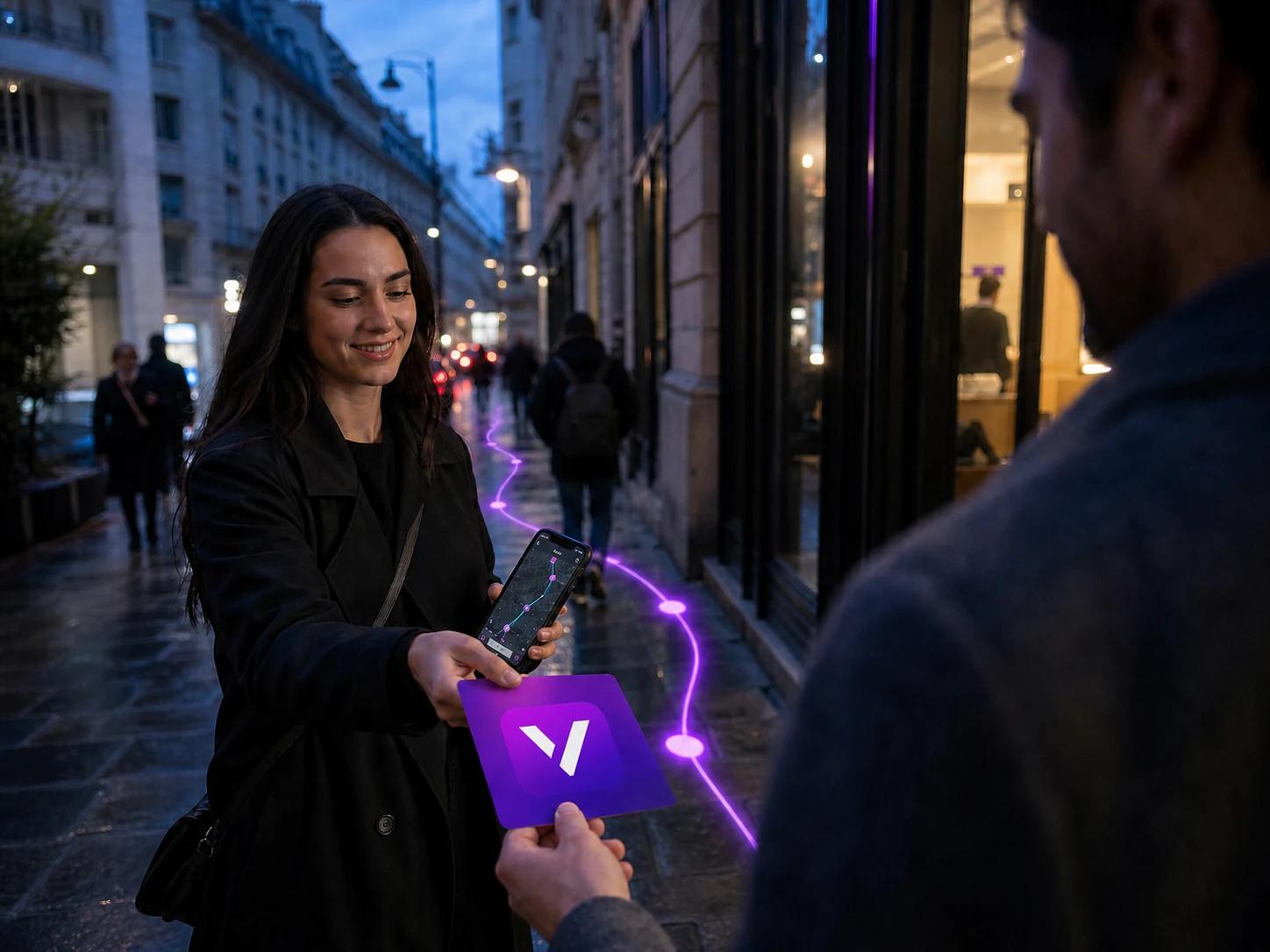
What: a simple flyer with a QR code straight into Vexub. One scan, one funnel, fully trackable.
How we measured: GPS-verified distribution on their side, QR scans and signups on ours. Offline handout, online conversion.
The strangest part was watching it happen. Our team had the campaign map open all day and it felt like tracking an Uber ride: ambassadors moving along the streets in real time, photo pins appearing one after another, flyer counts updating at each check-in. Nobody on our side had ever seen a field campaign that way. It changed the internal conversation from "did it happen?" to "what do we do with this data?".
The results
We are not publishing our absolute volumes, for competitive reasons. The ratios are what matter anyway, and they are the part we can share.
Roughly five times the conversion of the flyer campaign we had previously run with a traditional agency, on the same funnel: flyer in hand, QR scan, signup. Same product, same kind of flyer. The difference was where and to whom it was handed, and the fact that every handout was verified.
A new audience. Many of the customers who came through this campaign discovered Vexub for the first time. Paid social mostly reaches people who have already seen us. The street reached people who had not.
Profitable. The revenue from the cohort covered the cost of the operation. Our paid social spend over the same period cannot say that.
A funnel we can actually inspect. For reference, Strevoo's published benchmark for flyer distribution for tech startups is a 3 to 7% conversion on QR scans. Ours is a number we can now defend line by line, because we have the map, the photos and the scans behind it.
A follow-up post will go deeper into the funnel.
What surprised us
Three things we did not expect.
First, the discovery effect. We assumed flyers would mostly remind people of a brand they already knew. Instead, the campaign brought in users who had never crossed our ads. For a product that lives on screens, being found on a sidewalk turned out to be a genuinely new acquisition path.
Second, the debrief. The ambassadors' end-of-mission questionnaire told us which corners worked, which did not, and how people reacted to the pitch on the flyer. That is qualitative feedback we have never received from an ad platform.
Third, the proof changed how we budget. When you can show a map with every photo and every check-in, the finance conversation about "another wave" takes five minutes.
Why this fits a creator company (and maybe yours)
There is also a cultural reason this partnership makes sense to us. Strevoo's field teams are largely students and young side-hustlers earning money on flexible missions, the same demographic that uses Vexub to build channels and monetize content. If that is you and you are in France, they recruit brand ambassadors all year round.
A street campaign run by people who look like your users, talking to people who could be your users, is a very different thing from an impression counted somewhere in an auction.
What we are doing next
Our next test is two flyer designs on the same zones, handed out by different ambassadors, so the QR codes tell us which creative wins. We will publish that too, whatever it says.
If you run a digital product and have written off the physical world as unmeasurable, our advice is simple: it is not unmeasurable anymore. Test one wave, with GPS proof, and compare it to your paid social cost per signup. We would rather test a contrarian channel with proof than keep outbidding everyone for the same pixels.
Curious about the other side of this experiment? Strevoo documents its campaigns for brands like Orange, Jumbo and Sultan on its references page.