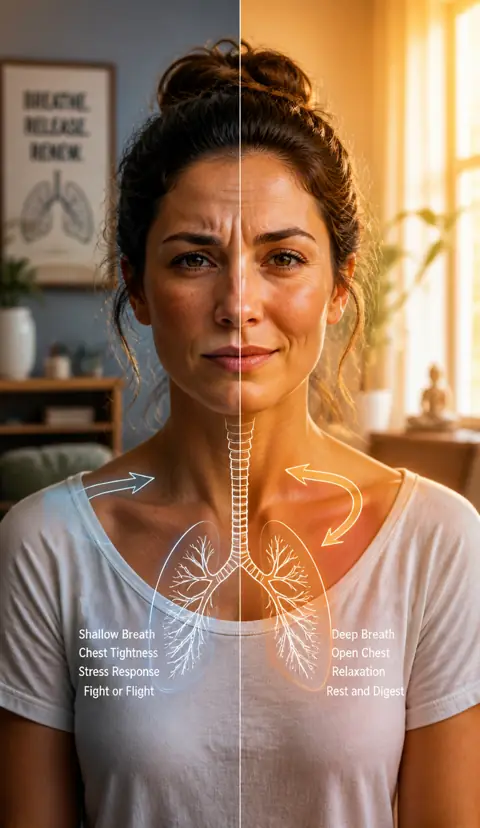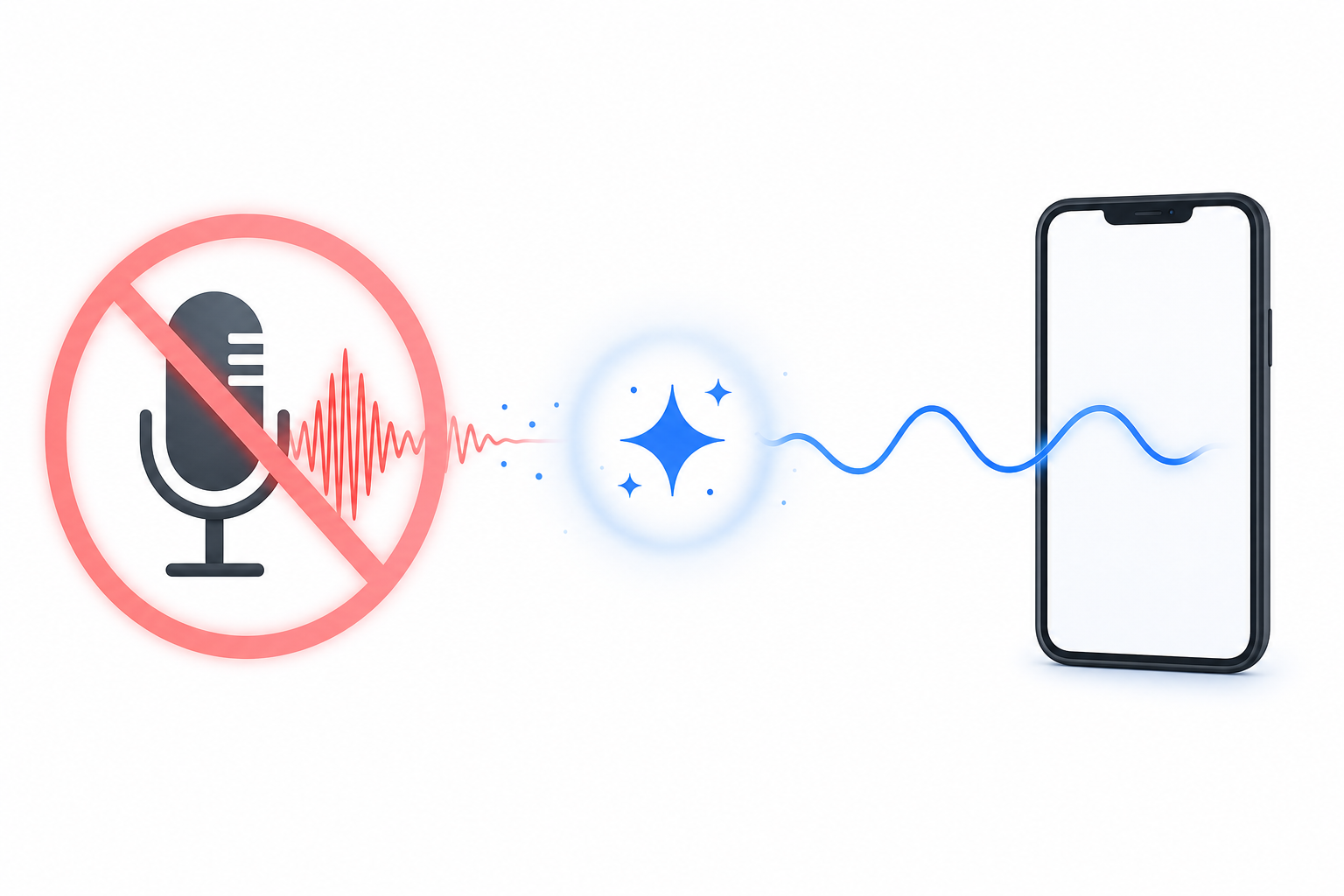
You hit record. You play it back. You cringe. You delete it. Your voice sounds high, weird, nasal, robotic, fake. Nothing like the voice you hear in your head. Welcome to one of the most universal blockers stopping people from making content. The good news: there's a real reason for this, it's not in your head, and there are 3 different paths around it. You'll find one that works.
Why your voice actually sounds different on video
When you speak, you hear yourself two ways: through your ears (air conduction) and through your skull (bone conduction). Bone conduction adds depth and bass to your voice. When you hear a recording, the bone conduction is gone, and only the airy version remains. So the voice on the video is technically the more accurate version, but it's the one your brain is least familiar with.
This is why almost everyone says 'I hate my voice on video.' It's not vanity. It's a literal mismatch between expectation and reality. Knowing the cause doesn't fix the cringe, but it makes it less personal.
Path 1: Get used to your voice
If you want to learn to use your real voice (which is the longest path but a strong one), here's what works:
Record yourself daily for 14 days. Just talking. Don't post. Don't edit. Listen back to all of them in one sitting on day 14. Your brain reaches a saturation point where the voice stops feeling foreign. This is documented in voice training research.
Hydrate before recording. A dehydrated voice sounds thin and high. A glass of water 20 minutes before makes a real difference.
Drop your voice 1 to 2 semitones. Most creators record at the top of their natural register because they're nervous. Slow down, drop the chest voice. Sounds 80% better instantly.
Stand up while recording. Sitting compresses your diaphragm. Standing opens it. Your voice gets resonance for free.
Path 2: Use a microphone that fixes the issue
Phone mics make almost everyone sound bad. A 50 dollar microphone fixes 70% of the 'I hate my voice' complaints because it captures lower frequencies and depth that bone conduction adds. Best entry options: a Lavalier USB-C mic or a Maono PD200X if you want USB. Don't buy a 300 dollar mic until you're sure you want to keep using your own voice.
If after a good mic you still hate it, your problem isn't the audio quality, it's the relationship with your voice. That's path 3.
Path 3: Use an AI voice (this is what most creators actually do in 2026)
This is the path most creators take, and the one most pros recommend if you're starting out. AI voices in 2026 are indistinguishable from human voices in most cases. They have natural pauses, breath, intonation, emotion. They don't sound like Siri anymore.
With Vexub you write your script and pick from a library of natural-sounding AI voices: deep masculine, warm feminine, energetic young, calm professional. The voice reads your script with proper pacing, and the video is built around it with visuals and captions automatically. You never have to record anything.
This is also a strategic move. Once you remove the voice friction, your output goes 5x. You can produce 5 videos in an evening instead of 1. The creators who win in 2026 are not the ones with the best voice, they're the ones who ship the most. AI voices remove the bottleneck.
Path 4: Use captions and music only
If you don't want AI voices either, you can build a channel that uses only captions, music, and visuals. This works incredibly well for motivational, philosophy, productivity, and aesthetic niches. Look at any successful 'lofi' or 'mindset' channel: half of them have no voice at all.
The mindset shift that helps
Your voice is the version your audience will hear. They don't have your inner reference. They don't expect bone-conduction bass. They hear what you've recorded and judge it on its own. If your message is clear and you sound calm, that's the experience. The cringe is a private problem, not a public one.
Pick the path that fits where you are right now. Most creators start with path 3, get to 1000 subs, and then experiment with their real voice when they feel less self-conscious. There's no rule saying you have to use your real voice. There's only one rule: ship the videos.
Read next: AI voice that sounds human for YouTube and How to make videos if you are shy.
Create videos like this with AI
Script, voiceover, images and subtitles — automated in minutes.