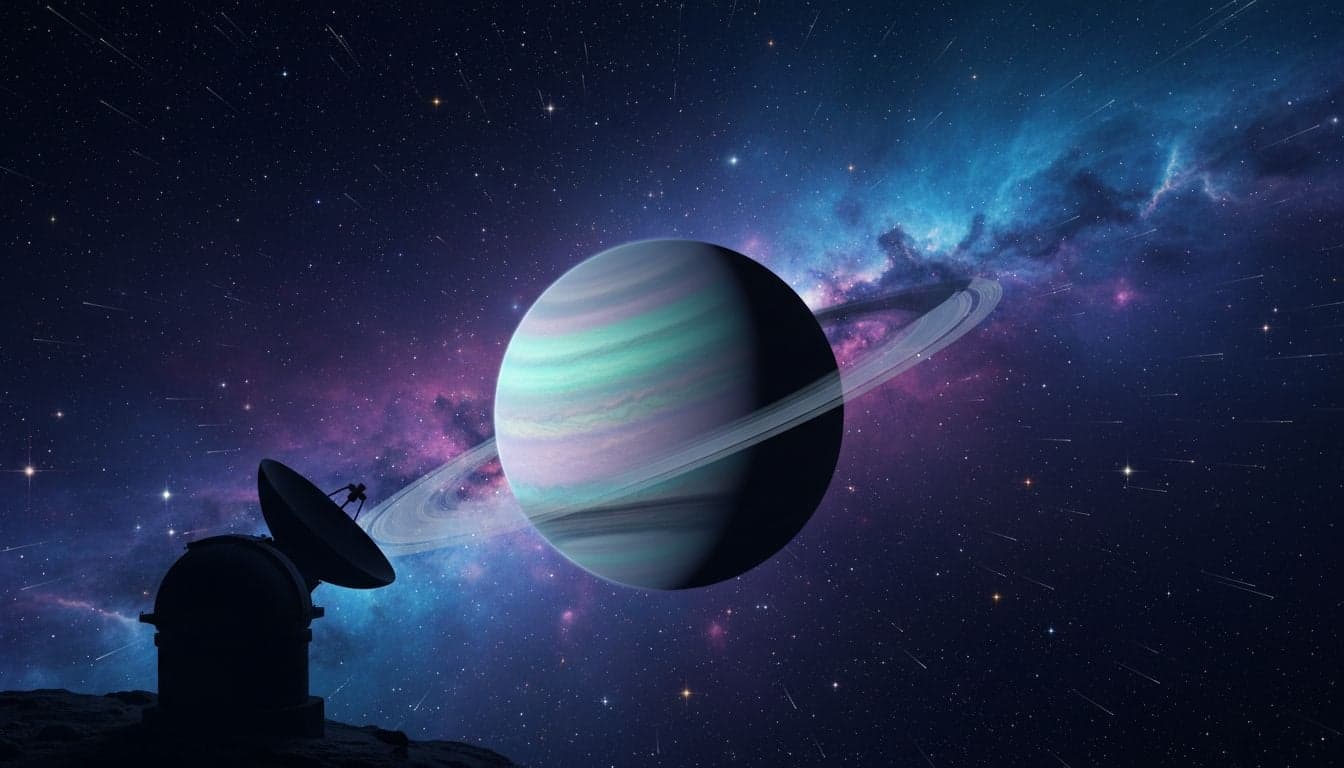
Space and astronomy content commands massive audiences on YouTube, with channels like Kurzgesagt and PBS Space Time pulling millions of views per video. The universe offers endless topics—black holes, exoplanets, stellar phenomena, cosmic mysteries—and viewers never tire of learning about what lies beyond Earth.
The best part? You don't need a telescope, a physics degree, or your face on camera. AI tools now generate stunning cosmic visuals and deliver polished narration that rivals professional documentaries. A space YouTube channel built with AI automation can produce weekly content while you focus on research and storytelling.
This guide walks you through building a faceless space and science channel from concept to monetization, using AI-generated imagery and voiceovers to create content that educates and captivates.
Why Space Content Dominates YouTube
Space and astronomy videos consistently outperform most other educational niches for several concrete reasons:
Universal fascination: Cosmic topics transcend language barriers and cultural boundaries. Everyone looks up at the stars and wonders.
Evergreen content: A video explaining neutron stars remains relevant for years. Scientific discoveries happen slowly enough that your content library stays valuable.
High RPM rates: Educational science content attracts premium advertisers and commands higher revenue per thousand views compared to entertainment niches.
Endless topic supply: From quantum mechanics to Mars colonization, the universe provides infinite angles for unique videos.
Visual spectacle: Space naturally offers dramatic imagery—supernovas, galaxy collisions, planetary formations—that hooks viewers immediately.
Channels in this niche regularly earn $15-40 per thousand views, significantly higher than the YouTube average of $2-5. The audience skews older and more educated, exactly what advertisers pay premium rates to reach.
Defining Your Space Channel's Focus
Space encompasses vast territory. Successful channels narrow their focus to build authority and audience loyalty. Consider these proven sub-niches:
Deep Space Phenomena
Cover black holes, quasars, gamma-ray bursts, and extreme cosmic events. Titles like "What Happens Inside a Black Hole?" or "The Largest Explosion Since the Big Bang" generate massive curiosity clicks.
Exoplanet Discovery
Document newly discovered worlds beyond our solar system. Profile potentially habitable planets, bizarre atmospheric compositions, and the technology finding these distant worlds.
Solar System Mysteries
Explore our cosmic backyard—Mars anomalies, Jupiter's storms, Saturn's rings, ocean worlds like Europa. Familiar yet fascinating topics that viewers understand immediately.
Theoretical Physics
Explain concepts like wormholes, time dilation, multiverse theories, and quantum mechanics in accessible ways. This sub-niche attracts highly engaged audiences willing to watch longer videos.
Space Exploration History
Chronicle the Apollo missions, Space Race milestones, or future colonization plans. Blend history with science for broader appeal.
Choose one primary focus for your first 50 videos. You'll establish credibility faster than channels jumping between unrelated space topics. As you grow, expand into complementary areas while maintaining your core identity.
Creating AI-Generated Space Visuals
Professional-looking space content no longer requires NASA footage or expensive stock libraries. AI image generation produces stunning cosmic visuals tailored to your exact narrative:
Vexub's AI video generator transforms scripts into complete videos with relevant space imagery. Describe "a binary star system with planets orbiting both stars" and the system generates matching visuals automatically. This eliminates hours of searching for appropriate footage.
Write detailed visual prompts: Instead of "black hole," specify "supermassive black hole with accretion disk glowing orange and blue, gravitational lensing visible, photorealistic style." Precision yields better results.
Maintain visual consistency: Use similar style descriptors across your channel. If you start with cinematic realism, switching to cartoon aesthetics midway confuses your audience.
Layer multiple image types: Combine wide cosmic vistas with closeup details. Show the full galaxy, then zoom to a specific stellar nursery within it.
Add motion through editing: Apply slow zoom effects, gentle pans, or rotation to static AI images. This creates the illusion of movement that keeps viewers engaged.
Generate comparison visuals: For size comparisons or before/after scenarios, create matching images from different angles or states. "Earth vs. Jupiter" needs both planets rendered in consistent style.
The key advantage of AI-generated space imagery is customization. Need a visualization of a theoretical concept that no photograph captures? Generate it. Want to show how a star evolves over billions of years? Create the sequence exactly as your script describes it.
Create videos like this with AI
Script, voiceover, images and subtitles — automated in minutes.
Scripting Educational Space Content
Great space videos balance scientific accuracy with engaging storytelling. Your script determines whether viewers click away or watch until the end:
Hook With Immediate Wonder
Open with a mind-bending fact or question. "A teaspoon of neutron star material weighs as much as Mount Everest" beats "Today we're talking about dense objects." Lead with the most fascinating element.
Use Relatable Analogies
Cosmic scales and physics break human intuition. Compare distances to familiar journeys: "If Earth were a marble, the nearest star would be 4,000 miles away." Translate abstract numbers into concrete imagery.
Build Narrative Momentum
Structure videos as stories with progression. Start with observation ("We detected strange signals"), add investigation ("Scientists analyzed the data"), reveal discovery ("They found a new type of cosmic phenomenon"), and end with implications ("This changes our understanding of...").
Address Common Misconceptions
Viewers arrive with preconceptions from science fiction. Clarify that space isn't completely silent, black holes don't suck everything nearby, and wormholes remain theoretical. Correcting myths builds trust.
Layer Simple to Complex
Introduce concepts progressively. Explain what a star is before diving into stellar fusion mechanics. Each section should build on previous knowledge without assuming expertise.
Check out our faceless YouTube channel guide for detailed scripting frameworks that work across educational niches. The principles adapt perfectly to space content.
AI Narration for Science Content
Your voice sets the channel's tone. Space content works well with calm, authoritative narration that conveys expertise without condescension:
Choose conversational over academic: Write how you'd explain the topic to an interested friend, not how you'd write a research paper. Use "you" and "we" to create connection.
Match pacing to complexity: Slow down for dense concepts. Speed up during familiar transitions. Varied pacing maintains attention better than monotone delivery.
Emphasize key numbers: When stating distances, temperatures, or timescales, give the AI voice slightly more emphasis. "Ten BILLION years" lands harder than flat delivery.
Add pronunciation guides: Scientific terms trip up AI voices. Phonetically spell unusual words in your script: "Sagittarius A-star (SAJ-ih-TAIR-ee-us AY-star)."
Test multiple voice options: Vexub offers various AI voice profiles. A British accent might convey authority for your audience, while American neutral works for broader appeal. Test both.
Quality narration separates amateur space channels from professional ones. Invest time perfecting your AI voice settings until the delivery sounds natural and engaging.
Optimizing Videos for Discovery
Creating excellent content means nothing if no one finds it. Space YouTube channels need strategic optimization:
Title Formulas That Drive Clicks
Successful space video titles follow proven patterns:
Number-based: "7 Planets That Shouldn't Exist"
Superlative: "The Most Extreme Star in the Universe"
Question: "What If You Fell Into a Black Hole?"
Timeline: "How the Universe Will End"
Discovery: "Scientists Just Found Something Impossible"
Avoid clickbait that disappoints. "This Planet Breaks Physics" only works if you explain genuine unusual physics. Misleading titles tank retention metrics, killing channel growth.
Thumbnail Strategy
Space thumbnails need immediate visual impact. Effective designs include:
High contrast between subject and background (bright object on dark space)
Maximum three visual elements (planet, text, arrow pointing at feature)
Vivid colors that pop in small sizes (electric blue, bright orange, deep purple)
Facial expressions of awe when using people (rare for faceless channels)
Scale comparisons visible at thumbnail size
Generate AI thumbnail images separately from video content, optimized specifically for 1280x720 pixels. What looks stunning in video might be invisible at thumbnail scale.
Strategic Keyword Targeting
Research what people actually search. "Black holes explained" gets 10,000 monthly searches. "Schwarzschild radius calculation" gets 100. Target the former, mention the latter in your video for depth.
Use YouTube's search suggestions, Google Trends for science topics, and competitor video titles to identify high-volume, low-competition keywords your channel can rank for.
Building a Content Pipeline
Consistency matters more than perfection. Channels posting weekly outperform those posting sporadically, even if individual videos are slightly less polished:
Batch your research: Spend one day reading recent astronomy publications, NASA announcements, and preprint servers. Compile 20-30 potential video topics.
Outline before scripting: Create bullet-point structures for five videos at once. This is faster than completing one video start-to-finish, then starting the next from scratch.
Generate assets in bulk: Request AI visuals for multiple videos in one session. You'll maintain consistent style better when creating related images together.
Establish quality thresholds: Define your minimum standards—1200-word script, 15+ visuals, two sources checked for accuracy. Meet these every video without perfectionism paralysis.
Schedule releases: Post same day and time weekly. Audiences develop viewing habits. "Tuesday morning space content" becomes part of their routine.
Vexub's automation handles video generation while you focus on research and storytelling. This division of labor lets solo creators maintain professional output schedules impossible through manual editing.
Monetization and Growth Strategies
Space channels reach monetization requirements faster than most niches due to high watch time. Educational content naturally encourages longer viewing sessions:
YouTube Partner Program
Educational science content qualifies easily. Aim for 8-12 minute videos—long enough for mid-roll ads without padding. Your high RPM rates mean fewer views needed for substantial income.
Sponsorships and Affiliates
Space channels attract sponsors selling telescopes, astronomy software, science books, and educational platforms. A 50,000-subscriber channel can command $500-2,000 per sponsored mention.
Join affiliate programs for space-related products. Star-gazing equipment, planetarium software, and science merchandise all convert well with astronomy audiences.
Digital Products
Create and sell space-themed resources—star charts, observation guides, or deep-dive courses on specific topics. Your authority in the niche makes audiences receptive to premium offerings.
Patreon or Channel Memberships
Offer early access, extended videos, or member-exclusive content. Science audiences support creators delivering consistent educational value.
The YouTube niche that quietly explodes details how educational channels build sustainable income through multiple revenue streams rather than depending solely on AdSense.
Maintaining Scientific Accuracy
Trust is currency in educational content. One factual error can damage your channel's credibility permanently:
Cite reputable sources: NASA, ESA, peer-reviewed journals, and established universities. Mention sources in video: "According to a 2025 study in Nature..."
Distinguish fact from theory: Clearly label speculative content. "Scientists theorize that..." or "Current evidence suggests..." acknowledges uncertainty.
Correct mistakes publicly: If you state something wrong, pin a correction comment and add a card in the video. Transparency builds rather than erodes trust.
Simplify without lying: Analogies should illuminate, not misinform. "Black holes are like cosmic vacuum cleaners" is acceptable. "Black holes suck in everything nearby" is false.
Stay current: Space science evolves rapidly. Update older videos with cards pointing to newer information when discoveries change understanding.
Your channel's reputation determines long-term success. Viewers forgive production quirks but abandon channels spreading misinformation.
Scaling Your Space Content Empire
Once your channel gains traction, expand strategically:
Create sub-series: "Planet Profile" episodes, "Cosmic Mystery" investigations, or "Space News This Week" segments give structure and set viewer expectations.
Cover breaking news: When JWST releases new images or missions make discoveries, rapid response videos capture search traffic and recommendation boosts.
Collaborate with science communicators: Guest appearances or shared projects expose your channel to established audiences while adding credibility.
Repurpose for other platforms: Extract short clips for TikTok, create infographic posts for Instagram, write companion blog articles. Your research supports multiple content formats.
Document your journey: Behind-the-scenes content about building a science channel attracts creator audiences while humanizing your brand.
Space content channels mature into media brands. Think beyond YouTube to podcasts, books, courses, or even consulting for science education initiatives.
Launch Your Cosmic Channel Today
Space and astronomy channels offer rare combination of passionate audiences, premium monetization, and infinite content possibilities. The universe literally never runs out of stories to tell.
AI tools removed the final barriers. You don't need film crews, expensive equipment, or even your face on camera. What matters is curiosity about the cosmos and commitment to sharing that wonder with others.
Start with one well-researched video about a topic that fascinates you. Generate stunning AI visuals that bring the concept to life. Let AI narration deliver your script with authority. Then publish and repeat weekly.
Your space content channel begins with a single upload. The universe is waiting.