TikTok ads have a unique problem: what works organically rarely works as paid content. Users scroll past obvious advertisements in milliseconds, and your ad spend evaporates before you see a single conversion. The difference between profitable campaigns and wasted budgets comes down to creative execution.
AI video tools have changed the economics of TikTok advertising. Instead of spending $5,000 on a production team to test one creative angle, brands now generate dozens of video variations in hours. The challenge shifts from production constraints to strategic testing—understanding which creative frameworks actually drive conversions.
This guide breaks down the specific AI video creation workflows that top-performing TikTok advertisers use to consistently hit positive ROAS. You'll learn the creative structures that stop the scroll, the testing frameworks that identify winners fast, and the AI tools that execute at scale.
Why Traditional Ad Creative Fails on TikTok
TikTok users have developed exceptional ad blindness. The platform's algorithm trains viewers to recognize and skip anything that looks like traditional advertising within the first 0.3 seconds. This creates three critical failures for conventional ad creative:
Polished production quality signals advertising: Professional lighting, studio backgrounds, and perfect audio mixing immediately trigger skip behavior. User-generated content aesthetics outperform production value by 3-4x in early testing metrics.
Brand-first messaging destroys engagement: Opening with logos, product shots, or company names tanks watch time. Successful ads disguise themselves as organic content for the first 3-5 seconds before revealing commercial intent.
Generic hooks blend into the feed: Phrases like 'Check out this amazing product' or 'You need to see this' have become white noise. Specific, curiosity-driven openings dramatically outperform generic CTAs.
AI video tools solve these problems by enabling rapid iteration. Instead of committing to one creative direction, you test 20 variations with different hooks, visual styles, and messaging frameworks. The data reveals what resonates before you scale spend.
The Hook-Value-CTA Framework for TikTok Ads
High-performing TikTok ads follow a three-part structure that balances platform expectations with conversion goals. This framework works because it respects user behavior patterns while driving commercial outcomes.
First 3 Seconds: Pattern Interrupts That Stop Scrolling
The opening moment must break user expectations without appearing like an ad. Effective pattern interrupts use visual or auditory elements that create confusion or curiosity:
Unexpected visual contrasts: Dramatic before/after splits, unusual camera angles, or deliberately imperfect framing that signals authenticity.
Provocative statements: Challenging conventional wisdom or making counterintuitive claims relevant to your product category.
Question-based hooks: Specific questions that target viewer pain points or aspirations, not generic engagement bait.
Using AI video generation tools, you can test dozens of opening variations by changing just the first scene or voiceover line. Track 3-second view rates to identify which hooks stop scrollers most effectively.
Seconds 4-15: Delivering Rapid Value
Once you've captured attention, deliver immediate value that justifies continued viewing. This middle section proves you understand the viewer's problem and have a legitimate solution:
Demonstrate product benefits through visual proof, not claims
Share specific results or outcomes that create desire
Use text overlays to reinforce key points for sound-off viewing
Maintain UGC aesthetic—avoid switching to polished product shots
The value section builds trust by showing rather than telling. If you're selling skincare, show real results with timestamps. If you're promoting software, show the interface solving a frustrating task. Visual evidence beats promotional copy every time.
Final 5 Seconds: Frictionless CTA
The call-to-action must feel like the natural next step, not a hard sell. Effective CTAs on TikTok: reduce friction by making the desired action seem easy and obvious:
'Link in bio' instead of 'Buy now' for cold traffic
'Try it free' instead of 'Sign up today' for SaaS products
Directional cues like arrows or animated elements pointing to the CTA button
AI tools let you test different CTA variations while keeping the hook and value sections identical. This isolated testing reveals which closing approach drives the highest click-through rates for your specific offer.
Create videos like this with AI
Script, voiceover, images and subtitles — automated in minutes.
AI Video Creation Workflow for TikTok Ads
The production workflow determines how quickly you can test and iterate. Speed matters because TikTok ad fatigue happens fast—creatives lose effectiveness within 5-7 days. Building a system that generates new variations in hours instead of weeks creates a sustainable competitive advantage.
Step 1: Script Multiple Hook Variations
Start by writing 10-15 different opening hooks for the same product. Use ChatGPT or Claude with this prompt framework: 'Write 10 pattern-interrupt hooks for a TikTok ad selling [product] to [audience]. Each hook should be 10 words or less and challenge a common belief about [problem].'
Organize hooks into categories:
Question hooks (5 variations)
Statement hooks (5 variations)
Challenge hooks (5 variations)
This gives you 15 distinct ad variations to test with minimal additional production work.
Step 2: Generate Visual Assets with AI
Use Vexub to transform your scripts into complete video ads. The platform handles: scene generation, voiceover synthesis, and subtitle placement—the three most time-consuming elements of video production.
For TikTok ads specifically:
Enable auto-captions for sound-off viewing
Select visual styles that match UGC aesthetics, not corporate polish
Use dynamic scene transitions to maintain viewing momentum
Add subtle motion graphics that enhance without overwhelming
The goal is producing 15 complete video ads in 2-3 hours instead of 2-3 weeks. This velocity enables real testing instead of guessing what might work.
Step 3: A/B Test Systematically
Launch all 15 hook variations simultaneously with identical budgets ($20-50 per ad). Run for 48 hours to gather statistical significance on early engagement metrics:
3-second view rate (primary hook performance indicator)
Average watch time (value section effectiveness)
Click-through rate (CTA strength)
Cost per click (overall ad efficiency)
Kill the bottom 10 performers after 48 hours. Double budgets on the top 5. This brutal testing approach finds winners fast without wasting spend on underperformers.
Advanced Creative Strategies That Drive ROAS
Once you've validated the basic framework, these advanced tactics separate good campaigns from exceptional ones. Top advertisers layer these elements to maximize conversion rates at scale.
Dynamic Product Insertion for Catalog Ads
If you're running TikTok Shop campaigns with multiple products, use AI to generate personalized video variations for different audience segments. A single script template with variable product names and benefits creates hundreds of targeted ads.
Example: 'This [product category] fixes [specific problem] in [timeframe]' becomes 50 unique ads by changing three variables. Vexub's batch generation tools handle the technical execution while you focus on strategic targeting.
User-Generated Content Simulation
Authentic UGC outperforms brand content, but real customer videos are inconsistent in quality and messaging. AI-generated videos that simulate UGC aesthetics—slight imperfections, casual delivery, authentic environments—capture the engagement benefits without sacrificing message control.
Key elements of UGC simulation:
Vertical 9:16 format with slight shakiness or movement
Natural lighting variations, not perfect studio setup
Conversational voiceover pacing with natural pauses
Visible text overlays that reinforce spoken content
This approach feels authentic because it respects platform norms while maintaining professional messaging standards.
Sequential Storytelling Across Ad Sets
Instead of treating each ad as independent, create narrative sequences that build over time. Users who see ad 1 this week see ad 2 next week, creating a story arc that deepens engagement.
Example sequence for fitness product:
Week 1: Problem awareness ('Why traditional workouts fail')
Week 2: Solution introduction ('This 15-minute method changes everything')
Week 3: Social proof ('1,000+ people got results')
Week 4: Urgency-based conversion ('Limited offer ends Friday')
AI tools make sequential campaigns economically viable by reducing the per-video production cost. You're investing in strategic narrative development rather than expensive production logistics.
Optimization Tactics for Sustained Performance
Creative testing never stops. TikTok's algorithm and user preferences shift constantly, requiring ongoing iteration to maintain performance. These optimization systems ensure your campaigns stay profitable long-term.
Weekly Creative Refresh Cadence
Establish a rhythm: every Monday, launch 5-7 new creative variations to test against current winners. This constant injection of fresh content combats ad fatigue before it tanks performance.
Use performance data from the previous week to inform new tests:
If 3-second view rates dropped, test new hooks
If CTR declined, experiment with different CTAs
If watch time decreased, adjust the value section pacing
Vexub's template system makes this weekly refresh manageable. Save your best-performing scripts as templates, then modify just the hook or CTA for rapid variation generation.
Audience Segment Testing
The same creative performs differently across audience segments. Run identical ads to different demographics, interests, and behavioral groups to find your highest-converting segments.
Test matrix example:
Age brackets: 18-24, 25-34, 35-44
Interest categories: 3-5 relevant interests per product
Lookalike audiences: 1%, 3%, 5% similarity
AI video tools enable this segmentation testing because you can produce creative variations at near-zero marginal cost. The data reveals which audiences respond to which messaging angles.
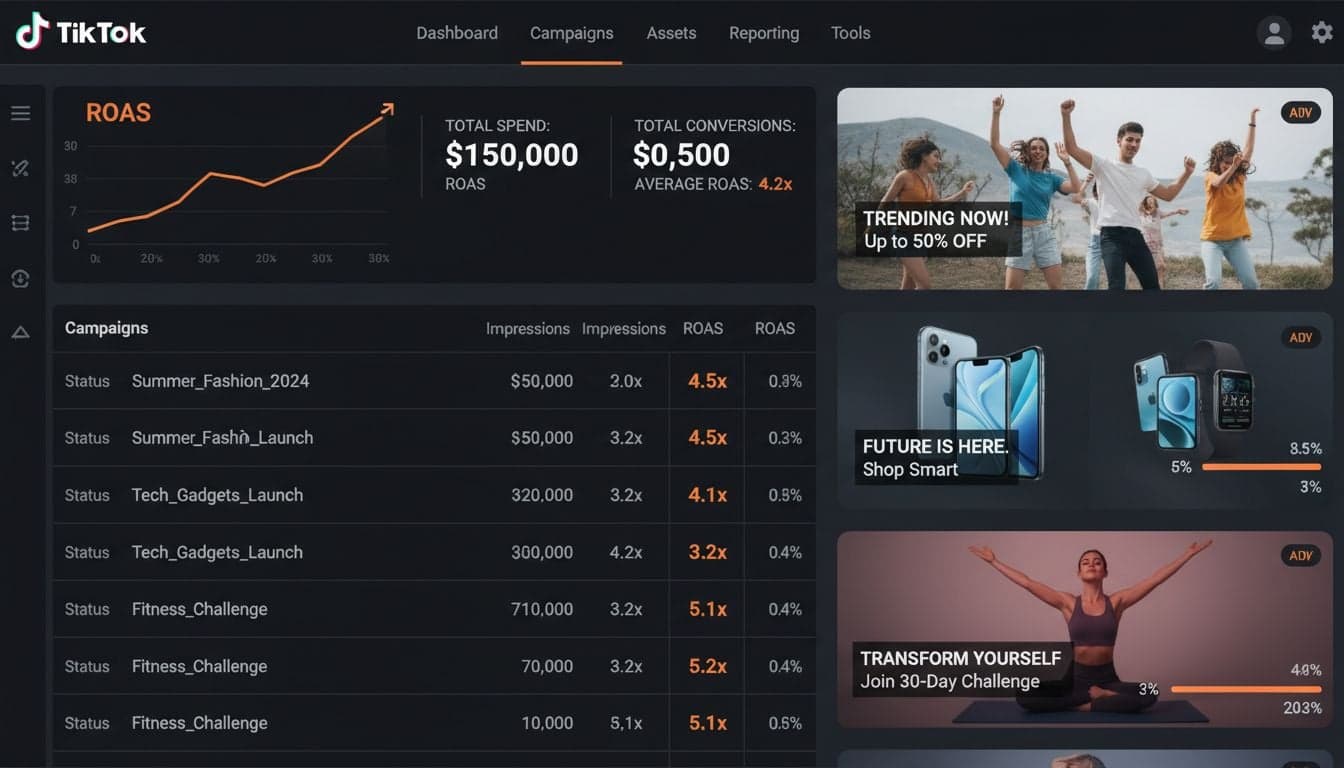
Performance Tracking Dashboard
Build a simple tracking system that monitors:
Creative fatigue indicators (declining engagement over time)
Audience saturation metrics (reach vs. frequency)
Cost efficiency trends (CPA changes week-over-week)
Creative element performance (which hooks, values, CTAs win)
This dashboard turns ad management from reactive firefighting into proactive optimization. You spot problems before they destroy profitability and double down on what's working before competitors copy your approach.
Common Mistakes That Kill TikTok Ad Performance
Even with AI tools and solid frameworks, these mistakes consistently destroy campaign results. Avoid them to protect your ad spend and maintain positive ROAS.
Over-Optimizing Too Early
Killing ads after 24 hours or $20 in spend doesn't provide statistical significance. TikTok's algorithm needs 2-3 days and 500+ impressions to properly deliver your creative to the right viewers. Premature optimization wastes the learning phase and prevents discovering potential winners.
Wait for meaningful data before making decisions. If an ad has high engagement but low conversions early on, it might need more time to reach purchase-intent viewers.
Ignoring Platform-Specific Best Practices
What works on Facebook or Instagram Reels often fails on TikTok. The platforms have different user expectations, content norms, and algorithm behaviors. Repurposing ads without adapting to TikTok's culture guarantees underperformance.
TikTok-specific requirements include:
Vertical 9:16 format (not square or horizontal)
Fast-paced editing with scene changes every 2-3 seconds
On-screen text that works without audio
Authentic aesthetic over polished production
Following the broader TikTok marketing principles ensures your ads respect platform culture while driving commercial results.
Relying on Single Creative Winners
Finding one high-performing ad creates dangerous overconfidence. Scaling all budget into that single creative accelerates fatigue and leaves you vulnerable when performance inevitably declines.
Always maintain 3-5 active creative variations, even when one clearly outperforms. This diversification protects against sudden drops and keeps fresh content in rotation.
Building Sustainable TikTok Ad Systems
Long-term advertising success requires systems, not one-off campaigns. The brands winning consistently on TikTok have built repeatable workflows that generate, test, and optimize creative at scale.
Your sustainable system includes:
Weekly creative production sprint (2-3 hours every Monday)
Automated performance tracking and alerts
Template library of proven frameworks
Clear decision rules for scaling and killing ads
AI video tools are the infrastructure that makes these systems economically viable. What previously required agencies and five-figure budgets now happens in-house with software subscriptions and strategic thinking.
The competitive advantage belongs to brands that can generate and test creative faster than competitors. Speed of iteration determines who finds winning combinations first and scales them before the market saturates. Build your system now to own that advantage.