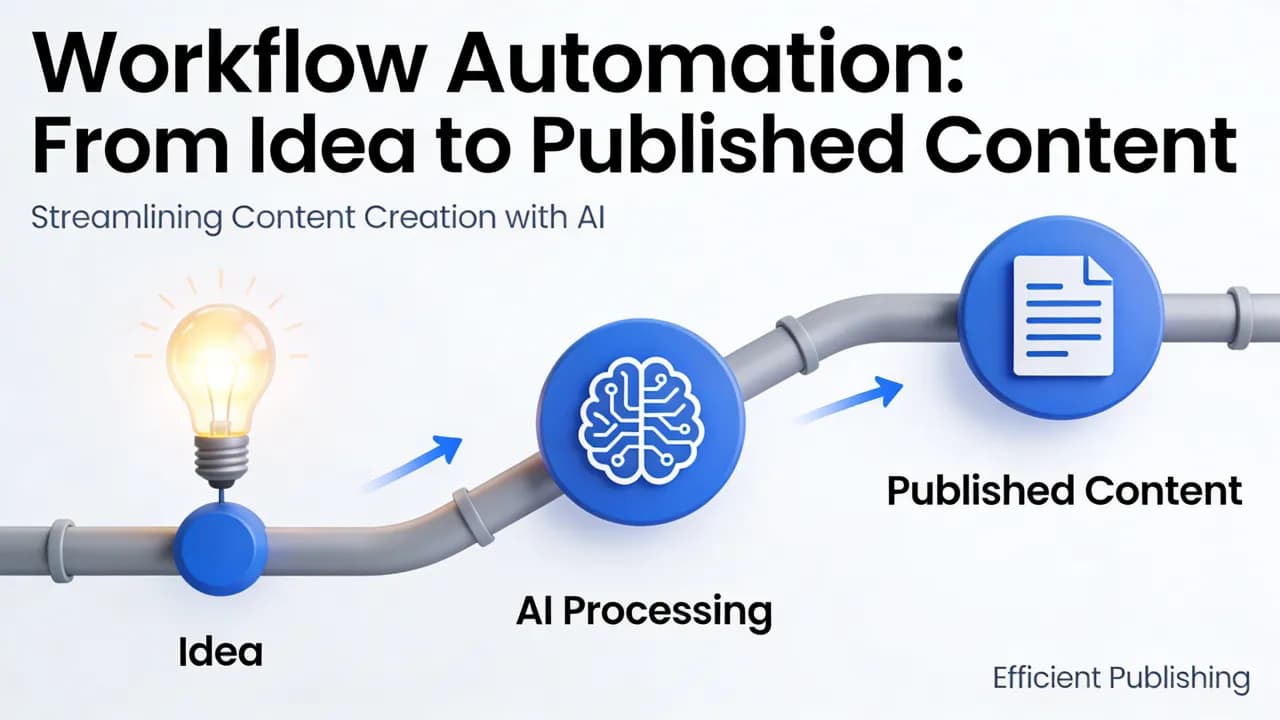
The difference between creators who publish once a month and those who publish daily is not talent or budget. It is workflow. An optimized AI content creation workflow transforms the chaotic, time-consuming process of making content into a streamlined pipeline that runs predictably and efficiently. This guide walks through every stage of that pipeline, from initial idea generation to final publication, showing exactly where AI fits in and where human judgment remains essential.
Why Workflow Matters More Than Tools
Most creators focus on finding the perfect tool. But a mediocre tool inside a great workflow will outperform a great tool with no workflow every time. A workflow is the sequence of steps, decisions, and handoffs that turn a raw idea into a published piece of content. When that workflow is well-designed and supported by AI at the right stages, you eliminate the bottlenecks that slow most creators down: blank-page paralysis, endless editing loops, manual formatting, and inconsistent publishing schedules.
The workflow described here is designed to work for solo creators and small teams producing video, blog, and social media content. Adapt it to your specific needs, but keep the core principle: every stage has a clear input, a defined process, and a measurable output.
Stage 1: Ideation and Topic Research
Every piece of content starts with an idea, but relying on inspiration alone is unreliable. AI-powered ideation turns this into a systematic process.
AI-Assisted Ideation Process
Seed with data: Start with keyword research tools like vidIQ, Ahrefs, or Google Trends to identify topics your audience is actively searching for. Feed these keywords into an AI assistant and ask for angle variations, sub-topics, and content gap analysis.
Analyze competitors: Use AI to summarize the top-performing content on your topic. Identify what they cover well and what they miss. Your content should fill those gaps.
Generate content calendars: Prompt your AI to create a 30-day content calendar based on your niche, target keywords, and platform mix. Review and adjust, but let AI handle the initial structure.
Validate ideas: Cross-reference AI suggestions with real search volume data and your own audience feedback. Not every AI suggestion will be a winner, and human judgment is critical here.
The output of this stage should be a prioritized list of content topics with target keywords, angle notes, and platform assignments. Store this in a shared document or project management tool like Notion.
Stage 2: Scripting and Outlining
With a validated topic in hand, the next step is producing a script or outline. This is where AI delivers the biggest time savings for most creators.
Create a detailed brief: Write a one-paragraph brief that includes the topic, target audience, key points to cover, desired tone, and any specific examples or data to include. The better the brief, the better the AI output.
Generate a first draft: Use an AI writing assistant like Claude to produce a full script or article draft from your brief. Specify the format: video script with timestamps, blog post with headers, or social media caption thread.
Human editing pass: This is the most important step. Read the AI draft critically. Add your unique perspective, correct any inaccuracies, inject personal anecdotes, and ensure the content reflects your authentic voice. AI generates the structure; you provide the soul.
Optimize for the platform: Adjust length, format, and structure for where the content will be published. A YouTube script needs hooks and retention techniques. A blog post needs SEO optimization. Social media needs punchy, scannable formatting.
Create videos like this with AI
Script, voiceover, images and subtitles — automated in minutes.
Stage 3: Production
Production is where the content takes its final form. The specific process varies by content type, but AI accelerates every variant.
Video Production Workflow
Generate voiceover: Paste your finalized script into an AI voiceover tool. For creators who use voice cloning, this step produces narration in your own voice without recording. Adjust pacing and emphasis as needed.
Assemble visuals: Use an AI video platform like Vexub to match visuals to your script automatically. The AI selects relevant stock footage, generates transitions, and places text overlays based on the narration timeline.
Add subtitles: Auto-generate subtitles using AI transcription. Subtitles increase engagement by 40 percent on average and are essential for mobile viewers watching without sound.
Review and adjust: Watch the assembled video from start to finish. Make manual adjustments to timing, visual choices, and audio levels. AI handles 80 percent of the work; your creative eye handles the remaining 20 percent.
Written Content Production
Format the edited draft in your CMS with proper headers, images, and internal links.
Run the content through an SEO tool like Surfer to optimize keyword density, readability, and structure.
Add custom images, charts, or infographics to support key points visually.
Include internal links to related content, such as your AI tools guide or other relevant articles.
Stage 4: Review and Quality Assurance
Quality control is the stage that separates professional content from amateur output. Build a checklist and use it for every piece of content before it goes live.
Accuracy check: Verify all facts, statistics, and claims. AI can hallucinate data. Cross-reference with primary sources.
Brand consistency: Ensure tone, visual style, and messaging align with your brand guidelines.
Technical quality: Check audio levels, video resolution, subtitle accuracy, and loading performance.
SEO verification: Confirm that the meta title, meta description, headers, and keywords are properly optimized.
Platform compliance: Verify that the content meets platform guidelines and policies. This is especially important for YouTube, which has strict content policies.
Stage 5: Publishing and Distribution
Publishing is not just hitting the upload button. A strategic approach to distribution multiplies the impact of every piece of content you create.
Publish to the primary platform first: Release on the platform where the content was primarily designed for, whether that is YouTube, your blog, or a podcast feed.
Repurpose for secondary platforms: Extract short clips from long videos, turn blog posts into social media threads, and convert key insights into carousel graphics. AI clipping tools like Opus Clip make this nearly automatic.
Schedule for optimal timing: Use platform analytics to identify when your audience is most active. Schedule posts accordingly rather than publishing everything at once.
Cross-promote: Share the content across all your channels with platform-native formatting. A YouTube link on Twitter performs poorly; a native video clip with a link in the comments performs well.
Engage with early responses: Respond to comments and questions within the first hour of publishing. Algorithm signals from early engagement significantly impact reach.
Stage 6: Analysis and Iteration
The final stage feeds directly back into Stage 1, creating a continuous improvement loop.
Review performance metrics for every piece of content after 7 days and again after 30 days.
Identify your top performers and analyze why they worked. Was it the topic, the format, the hook, or the timing?
Identify underperformers and diagnose the issue. Poor click-through rates suggest a thumbnail or title problem. Low retention suggests a content quality problem.
Feed these insights back into your ideation process. Double down on what works and cut what does not.
Track efficiency metrics too: time per piece of content, cost per piece, and output volume. Your workflow should get faster over time as you refine each stage.
To see how this workflow applies specifically to growing social media with AI video, check our dedicated platform growth guide.
Putting It All Together
An AI content creation workflow is not about replacing human creativity with automation. It is about removing the friction, repetition, and manual labor that prevent creators from doing their best work consistently. When ideation is systematic, scripting is accelerated, production is streamlined, and distribution is strategic, you free yourself to focus on the parts that actually require your unique perspective and creative judgment. Build the workflow once, refine it continuously, and let it compound your output and impact over time.