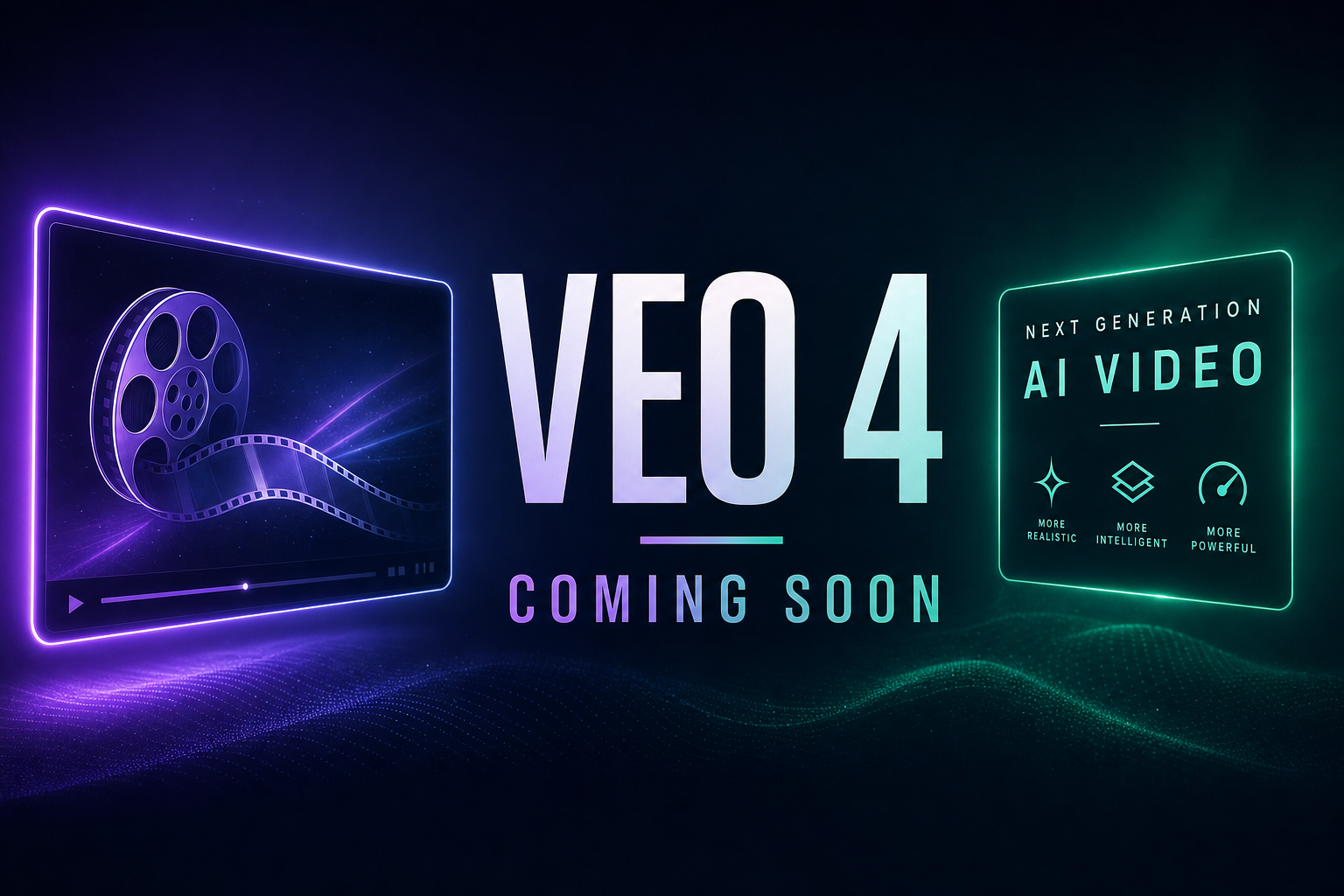
Google DeepMind teased VEO 4 in late March 2026, days after OpenAI confirmed Sora would be discontinued. The signals are strong: a Google I/O reveal in May 2026 looks likely, with general availability shortly after. Here's everything we know so far — and what to use right now while waiting.
Is VEO 4 released yet?
As of this article (mid-May 2026), VEO 4 is not officially released. Google DeepMind's team posted teaser signals on March 28-30, 2026, and the model is widely expected to be unveiled at Google I/O in May 2026. Based on Google's typical announcement cadence, public availability usually follows the I/O reveal by 2-8 weeks.
Until VEO 4 ships, the strongest production-ready models are VEO 3.1, Kling 3.0, Seedance, and (for a few more months) Sora 2.
What is VEO 4 expected to bring?
DeepMind has not published a feature list. Based on the technical roadmap shared in earlier presentations and patterns from VEO 3.1, here are the most credible expectations:
Native 4K output. VEO 3.1 already renders at 1080p with cinematic camera moves; VEO 4 is expected to match Kling 3.0's native 4K at 3840×2160 without upscaling.
Longer clip length. VEO 3.1 caps around 8 seconds per shot. Leaked benchmarks suggest VEO 4 may extend to 16-30 seconds per clip with maintained physics consistency.
Multi-shot scenes. DeepMind's research blog hinted at scene-aware multi-shot generation where multiple consecutive shots share lighting and subject consistency — a major leap for narrative content.
Improved audio sync. Native dialogue, ambient and music generation tighter to the visual track. VEO 3 already led the field here.
Better prompt fidelity. Smaller drift from the prompt over long generations, fewer hallucinated objects.
More efficient inference. Lower API cost per second is a strong signal — Google has been clear about scaling video AI economically.
When will VEO 4 launch?
Three signals point to mid-2026:
Google I/O 2026. DeepMind traditionally uses I/O to reveal flagship AI models. The May timing lines up.
DeepMind blog cadence. VEO 3 → VEO 3.1 happened roughly 6 months apart. From VEO 3.1 (October 2025) → VEO 4 would land around April-June 2026.
Sora discontinuation pressure. OpenAI announced on March 25, 2026 that Sora web and app will be discontinued on April 26, 2026, with the API following on September 24. Google has a window to consolidate the AI video market.
Create videos like this with AI
Script, voiceover, images and subtitles — automated in minutes.
VEO 4 vs VEO 3.1 — what changes
| Feature | VEO 3.1 (now) | VEO 4 (expected) |
|---|---|---|
| Max resolution | 1080p | Native 4K (3840×2160) |
| Clip length | Up to 8 seconds | 16-30 seconds (expected) |
| Multi-shot scenes | Single shot | Scene-aware consistency (expected) |
| Audio generation | Native dialogue + ambient | Tighter lip-sync (expected) |
| Prompt fidelity | Strong, occasional drift | Improved over long clips |
| API cost | Tier-based, mid-range | Expected lower per-second cost |
| Public availability | Available now | Mid-2026 (post Google I/O) |
What to use while VEO 4 isn't out
Three production-ready models cover almost everything VEO 4 is expected to deliver:
VEO 3.1 — for cinematic realism
VEO 3.1 still leads the field on photorealism, lighting, and prompt fidelity. If your project needs hyper-realistic shots (product, narrative, dramatic), VEO 3.1 is the strongest model available today.
Kling 3.0 — for native 4K and value
Kling 3.0 (released February 2026) ships native 4K rendering with surprisingly strong physics and motion. It costs less per second than VEO 3.1, which makes it the default choice for high-resolution at scale.
Grok — for speed and creative freedom
Grok video (xAI) generates faster than VEO and Kling, with looser content moderation that suits creative or experimental shots. Quality is below VEO/Kling on realism but speed compensates for rapid iteration.
How to access VEO 4 when it launches
Google will likely roll out VEO 4 in three stages:
Stage 1 — Limited preview. Selected creators, agencies and Google AI partners. Access via Vertex AI or Google AI Studio.
Stage 2 — Public preview with quota. Free monthly credits for personal Google accounts (similar to VEO 3.1's 100 monthly credits in 2026).
Stage 3 — General availability. Full API access, integration in third-party tools, paid tiers for higher quota.
If you use Vexub, you'll get VEO 4 access inside the platform as soon as the API lands, alongside the existing VEO 3, Kling and Grok integration — no separate subscription needed.
Should you wait for VEO 4 or start now?
Start now. Here's why:
VEO 3, Kling 3.0 and Grok cover 90% of what VEO 4 is expected to add.
Channels that wait for the next model usually lose 3-6 months of compounding ranking and audience growth.
Vexub's six creation modes already give you what most VEO 4 use cases will need — text-to-video, MP3-to-video, MP4-to-video, SMS Video, AI Video (VEO 3 / Kling / Grok), and YouTube clipping.
When VEO 4 ships, your content workflow stays the same — only the underlying model improves.
Bottom line
VEO 4 is coming, probably mid-2026, with bigger clips, native 4K and tighter audio sync. Until then, VEO 3.1, Kling 3.0 and Grok already cover most of what creators need. Don't wait to ship — start now and upgrade the model under the hood once VEO 4 lands.
Further reading
Create videos like this with AI
Script, voiceover, images and subtitles — automated in minutes.