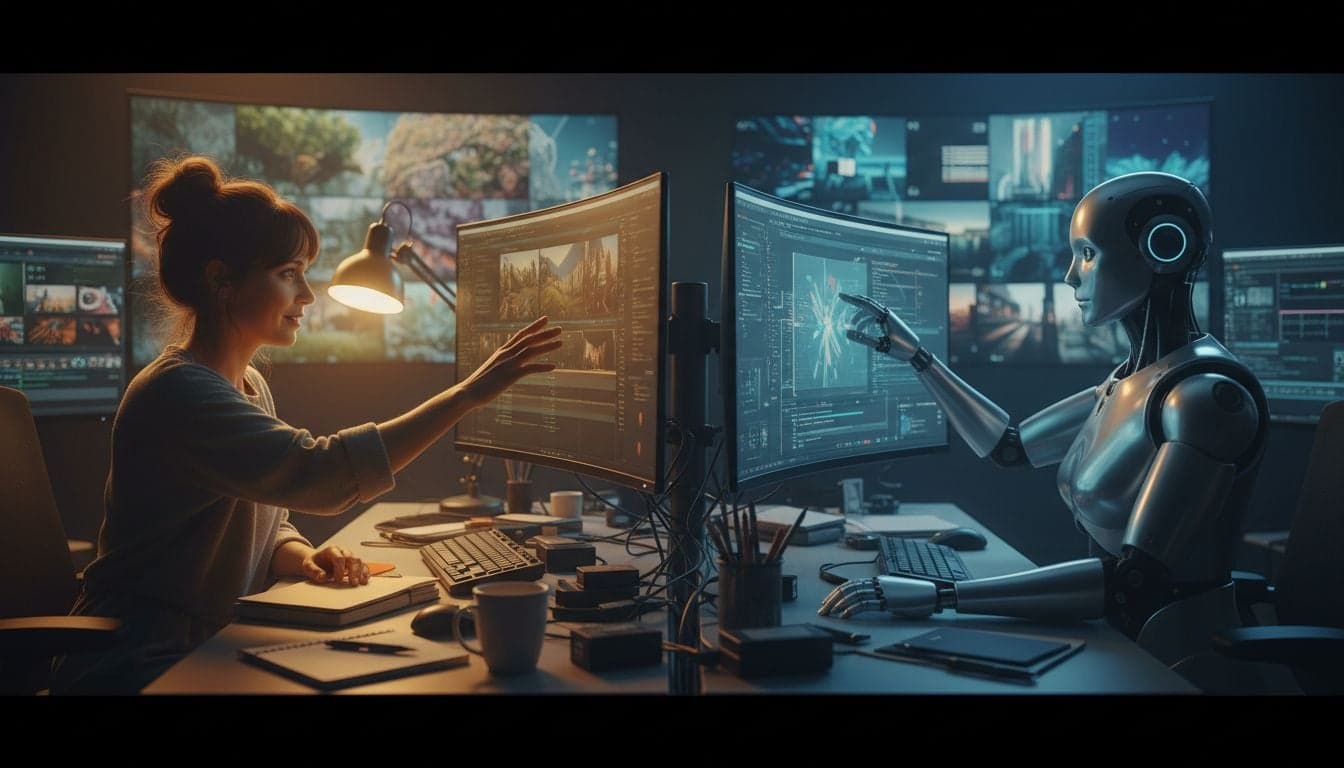
The video editing industry is experiencing its most dramatic shift in decades. AI tools now generate entire videos from text prompts, apply complex effects in seconds, and automate tasks that once took hours. For professional video editors, this raises an uncomfortable question: is your career at risk?
The short answer: AI won't replace video editors, but it will fundamentally change what being a video editor means. The editors who thrive in the next five years won't be those who resist AI—they'll be the ones who master it as another tool in their creative arsenal.
This analysis cuts through the hype and fear to examine what's actually happening in the video editing profession, which skills remain irreplaceable, and how smart editors are positioning themselves for the AI era.
What AI Actually Does Well in Video Editing
Understanding AI's genuine strengths helps separate reality from speculation. Current AI video tools excel at specific, well-defined tasks:
Automated cutting and trimming: AI identifies silent pauses, filler words, and optimal cut points in raw footage. Tools analyze speech patterns and can trim a 2-hour podcast into a tight 15-minute video without human intervention.
Color grading assistance: AI matches color profiles across clips, suggests LUT adjustments, and maintains consistency across projects. What took colorists 30 minutes per sequence now takes 3 minutes with AI suggestions.
Subtitle generation and synchronization: Speech-to-text AI creates accurate subtitles in dozens of languages, automatically timed to speech patterns. Platforms like Vexub generate subtitles with 95%+ accuracy, requiring minimal human correction.
Template-based content creation: AI generates complete videos from text prompts for specific formats—social media clips, product demos, explainer videos. These work best for standardized content types.
Audio enhancement: AI removes background noise, balances audio levels, and even generates music tracks that adapt to video pacing.
These capabilities are impressive and genuinely useful. They've already changed daily workflows for thousands of editors. But they represent automation of mechanical tasks, not creative decision-making.
What AI Still Can't Replace
Despite rapid advances, AI struggles with the core elements that define exceptional video editing:
Narrative Judgment and Story Arc
AI doesn't understand why a particular sequence of clips creates emotional impact. A skilled editor knows when to hold on a reaction shot for two extra seconds, when to cut away for dramatic tension, or when to break conventional pacing rules for effect. These decisions require understanding human psychology, cultural context, and narrative tradition—areas where AI remains fundamentally limited.
Consider a documentary about climate change. An editor might juxtapose footage of melting glaciers with children playing on a beach—not because the shots are visually similar or algorithmically related, but because the contrast creates a specific emotional resonance. AI can't make that conceptual leap.
Client Communication and Creative Interpretation
Video editing is collaborative. Clients say things like "make it pop more" or "it needs to feel more premium" or "the energy is off in the middle section." Skilled editors translate vague creative direction into specific technical choices. They understand that "make it pop" might mean faster cuts, higher contrast, or more dynamic motion graphics depending on context and client personality.
AI can't participate in this interpretive dialogue. It can't read a room, sense client hesitation, or propose creative alternatives when the original direction isn't working.
Cultural Nuance and Brand Voice
Every brand has a distinct voice. Some require polished, corporate editing. Others need raw, authentic cuts. Some audiences respond to quick-cut energy; others prefer contemplative pacing. Editors develop intuition about these nuances through experience—understanding what will resonate with specific demographics, platforms, and brand identities.
AI might generate technically competent edits, but it doesn't grasp why a slow, cinematic approach works for a luxury watch brand while the same pacing would kill engagement for a fitness supplement.
Create videos like this with AI
Script, voiceover, images and subtitles — automated in minutes.
The Hybrid Editor: How Professionals Are Adapting
The most successful video editors aren't fighting AI—they're integrating it into their workflows to become more efficient and valuable. This hybrid approach combines AI's speed with human creativity and judgment.
Task Delegation Strategy
Smart editors now think in terms of value creation. They delegate low-value, time-consuming tasks to AI while focusing their expertise on high-impact creative decisions:
First pass automated: Use AI to create rough cuts, generate subtitle drafts, and apply basic color correction.
Human refinement: Review AI output and make nuanced adjustments—adjusting pacing for emotional impact, selecting B-roll that reinforces narrative themes, fine-tuning color grades for specific moods.
Creative problem-solving: Spend saved time on creative experimentation, testing different narrative approaches, and developing unique visual styles that differentiate their work.
This approach can reduce project turnaround time by 40-60% while maintaining or improving creative quality. One editor reported completing client projects in 3 days that previously took a week, then using the extra time to develop a signature style that tripled their rates.
Expanding Service Offerings
AI tools enable editors to offer services that were previously impractical. An editor who specializes in corporate videos can now also handle high-volume social media content creation using AI generation for initial drafts. Someone focused on long-form content can efficiently produce short-form derivatives.
Vexub users report taking on 3-4 additional clients because AI handles the repetitive aspects of content creation, allowing them to supervise and refine more projects simultaneously. The future of AI video creation points toward editors becoming creative directors who oversee AI execution rather than manually performing every edit.
Which Video Editing Jobs Are Most Vulnerable
Not all video editing roles face equal AI pressure. Some positions are more susceptible to automation than others:
High-Risk Positions
Template-based content editors: Editors who primarily assemble pre-designed templates for corporate presentations, standard product videos, or basic social media content face the most immediate pressure. AI can now generate these videos from text descriptions with minimal human input.
Basic subtitle and caption work: Pure transcription and subtitle timing—once a reliable income source for many editors—has been almost entirely automated by AI with near-perfect accuracy.
High-volume, low-customization work: Editing roles that involve processing large quantities of similar content with minimal creative variation (like basic real estate walkthrough videos or standard product demos) are increasingly handled by AI systems.
Low-Risk Positions
Narrative-driven projects: Documentaries, branded content, commercials, and any work requiring strong storytelling remain firmly in human territory. The creative judgment required can't be replicated by current AI.
High-touch client work: Projects involving extensive client collaboration, feedback cycles, and creative iteration require the communication skills and flexibility that AI lacks.
Specialized technical editing: VFX integration, advanced color grading, complex motion graphics, and technical problem-solving in post-production remain human domains.
Creative direction and supervision: Editors who've evolved into creative leadership roles—directing AI tools, managing workflows, and making high-level creative decisions—are more valuable than ever.
Skills That Future-Proof Your Video Editing Career
The editors thriving five years from now will combine traditional editing expertise with new capabilities. Here's where to focus your professional development:
Master AI Tool Integration
Learn to work with AI rather than resist it. Familiarize yourself with AI video generation platforms, automated editing tools, and AI-assisted color grading. Understanding these tools' strengths and limitations makes you more efficient and enables you to deliver faster without sacrificing quality.
Spend time experimenting with platforms like Vexub to understand what AI-generated content looks like and how to efficiently refine it. The comparison between AI and human voiceover reveals similar patterns—AI handles the mechanical aspects excellently, but human expertise elevates the final result.
Develop Strong Creative Direction Skills
As AI handles more technical execution, the ability to direct that execution becomes paramount. Practice articulating creative vision, providing precise feedback, and making conceptual decisions about narrative flow and emotional pacing. These meta-editing skills—the ability to envision and guide a project rather than just execute cuts—are what separate editors from AI operators.
Specialize in Complex Formats
Position yourself in editing niches that require sophisticated judgment. Long-form documentaries, narrative commercial work, music videos with artistic ambition, and experimental content all demand creative capabilities beyond AI's current reach. Specialization also commands premium rates that justify human expertise.
Build Client Relationship Skills
Your ability to understand client needs, translate vague requests into concrete deliverables, and navigate creative feedback becomes a competitive advantage. AI can't build relationships or manage the human side of creative projects. Editors who excel at client communication remain indispensable regardless of technological advances.
The Real Future: Editors as Creative Directors
The video editing profession isn't disappearing—it's elevating. Just as digital tools didn't eliminate photographers but changed what photography meant, AI won't eliminate editors but will redefine the role.
Tomorrow's successful video editors will be creative directors who happen to use AI as one of many tools. They'll spend less time on repetitive technical tasks and more time on creative strategy, narrative development, and client collaboration. They'll oversee AI-generated content the way film editors oversee assistant editors—reviewing, refining, and elevating work that others (or AI systems) produce.
The key insight: AI doesn't replace creativity and judgment. It replaces execution of well-defined tasks. Editors who lean into the creative and strategic aspects of their work—and delegate mechanical tasks to AI—will find themselves more valuable, not less.
Your career isn't threatened by AI tools. It's threatened by other editors who learn to use AI tools better than you do. The question isn't whether AI will replace video editors. The question is whether you'll adapt fast enough to remain one of the editors who matters.
Start experimenting with AI tools today. Learn their capabilities and limitations. Discover where they save time and where human judgment remains essential. The editors who make this transition now will be the ones leading the industry in 2030.