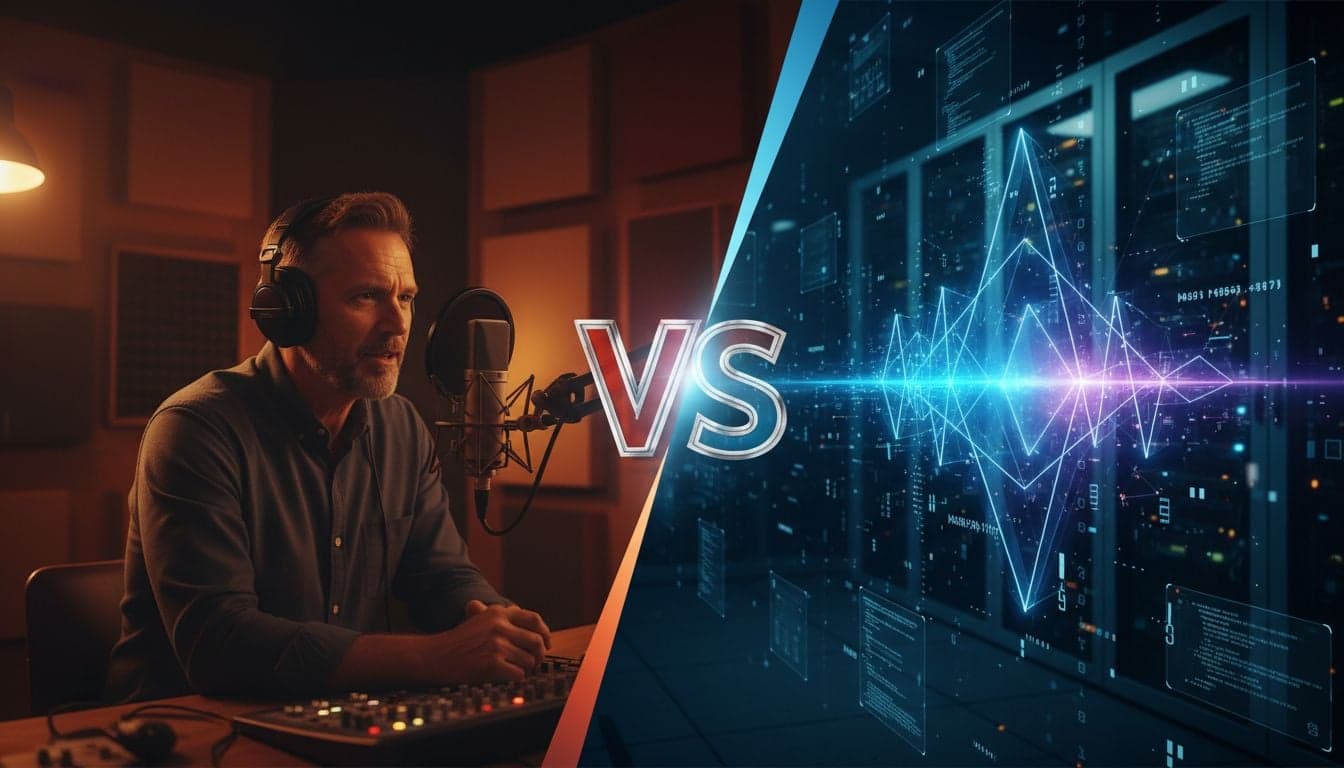
The AI voiceover industry crossed a threshold in late 2025 that most creators missed: premium AI voices became indistinguishable from human narrators in blind tests. Yet human voice actors still dominate major productions. This isn't about one being definitively better—it's about matching the right voiceover type to your specific content.
I've produced over 500 videos using both AI and human voiceovers across YouTube, TikTok, and Instagram. The quality gap has narrowed dramatically, but distinct differences remain that affect which option works best for educational content, entertainment, ads, or social media shorts.
This comparison examines actual quality differences, real-world use cases, and the specific scenarios where each option excels. No hype, no bias—just practical guidance based on what actually matters for video performance.
Audio Quality: The Technical Reality
Modern AI voiceover quality depends entirely on which technology you're comparing. Legacy text-to-speech engines sound robotic and unnatural. Neural TTS from 2024-2025 reached "acceptable" quality. Current-generation AI voices using transformer models achieve near-human realism.
Human voice actors deliver consistent quality across the board, but with natural variation. Their recordings include authentic breathing patterns, emotional micro-expressions in tone, and organic pacing changes. These elements create a connection that listeners perceive as genuine.
What AI Voices Do Well
Pronunciation accuracy: AI voices nail technical terms, brand names, and foreign words with perfect consistency every time.
Volume consistency: Zero variation in recording levels—no need for audio normalization or compression.
Speed control: Adjust pacing from 0.5x to 2x without affecting pitch or quality.
Accent variety: Access dozens of regional accents and languages instantly without hiring multiple actors.
Where Human Voices Excel
Emotional range: Subtle sarcasm, genuine excitement, or authentic empathy that connects with audiences on a deeper level.
Script interpretation: Professional actors understand context and adjust delivery to match the intended meaning beyond just the words.
Character work: Distinct character voices for storytelling, dialogue, or entertainment content require human creativity.
Brand authenticity: For premium brands, the organic quality of human narration reinforces perceived value.
Cost Analysis: The Real Numbers
Pricing reveals the most dramatic difference between AI and human voiceover. The economics fundamentally change how creators approach video production at scale.
Professional human voice actors charge $100-$500 per project for YouTube videos (10-15 minutes). Social media shorts run $50-$150 per video. Celebrity voices or union talent can exceed $1,000 per project. Most creators pay $200-$300 per finished video on average.
AI voiceover through platforms like Vexub costs $19-$49 per month for unlimited generation. That's unlimited videos, unlimited revisions, unlimited voice options. The math changes dramatically when producing multiple videos weekly.
Production Speed: Time Is Content
Human voice actors require 48-72 hours minimum turnaround for most projects. Rush delivery adds 50-100% cost premiums. Script revisions mean scheduling another recording session, adding days to your timeline.
The workflow looks like this: finalize script → send to voice actor → wait for recording → review → request revisions → wait again → receive final files → edit into video. Total timeline: 3-7 days for a single video.
AI voiceover generation takes 30-90 seconds. Script changes? Regenerate in under a minute. Want to test different voices? Try five options in five minutes. The entire workflow from script to finished voiceover: under 10 minutes.
Vexub users create complete AI-generated videos in under 20 minutes including voiceover, visuals, and subtitles—a process that traditionally required days.
Create videos like this with AI
Script, voiceover, images and subtitles — automated in minutes.
Content Type Breakdown: What Works Where
The honest answer to "AI or human voiceover" depends entirely on your content type. Some formats benefit from AI's consistency, others require human authenticity.
Educational & Tutorial Content
Recommendation: AI voiceover — Educational videos prioritize clarity, consistency, and information delivery. AI voices like those in Vexub's AI voiceover system deliver perfect enunciation, consistent pacing, and professional tone without the "personality" that can distract from learning.
Viewers watching tutorials care about understanding the content, not connecting emotionally with the narrator. AI's neutral, clear delivery actually improves comprehension for complex topics.
Entertainment & Storytelling
Recommendation: Hybrid or Human — Entertainment content benefits from emotional delivery and character work. Horror stories, true crime narratives, or dramatic content often need the authentic fear, excitement, or tension that human actors provide.
However, creators like MrNightmare and numerous faceless horror channels successfully use AI voices by leaning into the slightly artificial quality as part of the eerie atmosphere. The key is matching voice style to genre expectations.
Social Media Shorts (TikTok, Instagram, YouTube)
Recommendation: AI voiceover — Short-form content thrives on volume and consistency. Posting daily or multiple times daily makes human voiceovers financially impractical. AI voices perfectly suit the fast-paced, information-dense nature of social shorts.
The best AI voice generators now offer energetic, engaging voices that match the vibe of viral short-form content. Audiences on these platforms expect polished but efficient delivery—exactly what AI provides.
Brand Commercials & Advertisements
Recommendation: Human voiceover — Premium brands and professional advertisements still favor human voices for perceived authenticity. When selling products or services, the emotional connection from a human narrator increases trust and conversion rates.
Budget brands and direct-response ads increasingly use AI voices successfully, especially when targeting younger demographics who've grown up with AI-generated content and don't perceive it as "less than."
Podcast & Long-Form Audio
Recommendation: Human voiceover — Long-form audio requires personality and authentic connection. Listeners spend 30-60 minutes with your voice—AI's subtle artificial qualities become more noticeable over extended periods.
The exception: Some creators successfully use AI for podcast editing tasks like ad reads, intro/outro segments, or recap sections while maintaining human hosts for main content.
Audience Perception: What Viewers Actually Think
Multiple blind tests conducted in 2025-2026 revealed surprising results about audience perception of AI versus human voiceovers. When viewers don't know they're listening to AI, quality matters more than source.
Studies showed that premium AI voices in educational content received higher "clarity" ratings than some human narrators who had regional accents or inconsistent recording quality. Viewers rated the content as more professional specifically because the AI voice maintained perfect consistency.
For emotional content, human voices still won preference—but only when listeners were told they were comparing AI versus human. In true blind tests where viewers didn't know which was which, the quality gap narrowed to less than 10% preference.
The biggest perception shift: younger audiences (18-34) show no inherent preference for human over AI voices. They evaluate purely on quality and clarity, not the technology behind the recording.
The Hybrid Approach: Best of Both Worlds
Smart creators don't choose one option exclusively. The most effective strategy combines both based on specific needs for each project.
Weekly content: Use AI voiceover for consistent, frequent uploads that maintain your publishing schedule without budget constraints.
Flagship content: Invest in human voice actors for major releases, channel trailers, or important announcements that represent your brand.
Testing & iteration: Use AI to test scripts, pacing, and content concepts before investing in human recording sessions.
Localization: AI voices make multilingual content economically viable—record once in English with a human, use AI for Spanish, French, German, etc.
Seasonal scaling: Human voiceovers during low-production periods, AI when ramping up content volume for seasonal pushes.
Quality Markers: How to Evaluate Voiceover Options
Whether choosing AI or human voiceover, evaluate these quality markers to ensure professional results:
Pronunciation accuracy: Test with technical terms, brand names, and numbers specific to your niche.
Pacing consistency: Does the delivery match your content's rhythm? Too fast overwhelms viewers, too slow loses attention.
Emotional appropriateness: The tone should match content type—energetic for entertainment, calm for meditation, authoritative for education.
Background noise: Human recordings sometimes include room tone or mic noise. AI is perfectly clean but can feel "too perfect" for some content.
Breath sounds: Natural breathing adds realism. Some AI voices include artificial breath sounds; others are completely breathless.
The Future Is Already Here
Voice cloning technology allows creators to generate AI versions of their own voices. You record 5-10 minutes of sample audio, and AI replicates your unique vocal characteristics for unlimited content generation.
This solves the authenticity problem—it's still YOUR voice, just AI-generated for efficiency. Creators use voice cloning to maintain their personal brand while producing content at scale. Record one session, generate hundreds of videos without ever speaking again.
Vexub's AI voice cloning feature enables this workflow for content creators who want personal authenticity with AI efficiency. It's particularly powerful for educational creators and personal brands where audience connection matters.
Making Your Decision
The AI versus human voiceover debate isn't about which technology is "better"—it's about matching tools to goals. AI voiceover excels at consistency, speed, and cost-efficiency for volume content production. Human voiceover delivers emotional authenticity, brand prestige, and creative interpretation for high-stakes projects.
Most successful creators use both strategically. Start with AI for your regular content pipeline to maintain consistency and manage costs. Invest in human voice actors for flagship content that defines your brand. Test both options and let audience engagement metrics guide your decision.
The quality gap continues narrowing. What seemed impossible for AI voices in 2023 became standard by 2026. The question isn't whether AI can match humans—it's which option serves your specific content goals most effectively.