AI video editing is one of the most accessible ways to start creating video content in 2026. You do not need years of experience with professional editing software or an expensive hardware setup. Modern AI-powered editors handle the tedious parts of video production, like cutting, captioning, and color correction, so you can focus on telling your story.
This guide is written specifically for beginners. If you have never edited a video before, or if you have tried and felt overwhelmed by traditional software like Premiere Pro or DaVinci Resolve, AI editing tools offer a much gentler learning curve. We will cover the core concepts, walk through the essential tools, and give you a practical workflow you can follow today.
What Makes AI Video Editing Different
Traditional video editing requires you to make every decision manually. You drag clips onto a timeline, set in and out points, adjust keyframes for animations, and tweak audio levels frame by frame. It is powerful but time-consuming, and the learning curve is steep.
AI video editing automates many of these tasks. Instead of manually scrubbing through footage to find the best moments, an AI can analyze your raw clips and suggest cuts. Instead of typing out subtitles word by word, speech recognition generates them in seconds. Instead of manually color-grading every shot, AI matches the visual tone across your entire project.
The result is a workflow that takes minutes instead of hours, especially for straightforward content like social media posts, product demos, and talking-head videos.
Essential Concepts for Beginners
The Timeline
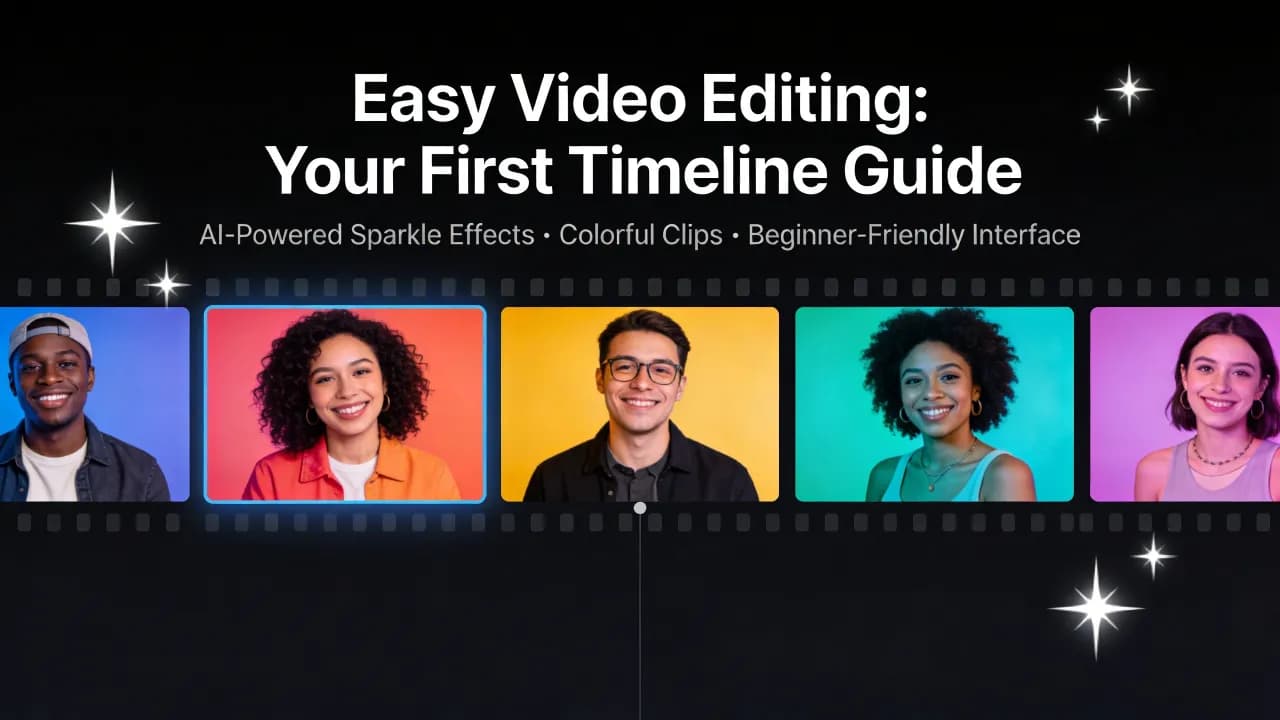
Every video editor, AI-powered or not, is built around a timeline. The timeline is a horizontal track where you place video clips, audio tracks, and text overlays in sequence. Clips on the left play first, clips on the right play later. Most AI editors simplify the timeline so you see only what you need, but the concept is the same.
Cuts and Transitions
A cut is the most basic edit. It is the point where one clip ends and the next begins. A hard cut, where the video instantly switches from one clip to another, is the most common type and works well in almost every situation. Transitions like cross-dissolves or wipes add visual flair but should be used sparingly. AI tools can suggest optimal cut points based on pacing, silence detection, and scene changes.
Aspect Ratios
Aspect ratio is the relationship between the width and height of your video. The three you will use most often are:
16:9 (landscape): Standard for YouTube, websites, and presentations. This is the default for most content.
9:16 (portrait): Used for Instagram Reels, TikTok, YouTube Shorts, and other vertical-first platforms.
1:1 (square): Popular on Instagram feeds and LinkedIn. A good middle ground when you need to work across platforms.
Audio Layers
Video is only half the experience. Your project will typically have multiple audio layers: narration or dialogue, background music, and sound effects. Good audio mixing means your narration is always clearly audible, with music sitting 10-15 dB lower. AI editors can auto-balance these levels for you.
Create videos like this with AI
Script, voiceover, images and subtitles — automated in minutes.
Choosing Your First AI Video Editor
Not all AI video editors are created equal. Here is what to look for as a beginner:
Simplicity: The interface should not overwhelm you with options. Look for editors that guide you through the process step by step.
Auto subtitles: Captioning is essential for social media. Choose a tool that generates accurate subtitles automatically and lets you edit them easily.
Templates: Pre-built templates help you produce polished videos quickly without making every design decision from scratch.
AI voiceover: If you do not want to record your own narration, AI voiceover lets you convert text to natural-sounding speech in dozens of languages.
Free tier: Start with a free plan so you can learn without financial pressure. Upgrade when you outgrow the free limits.
Vexub checks all of these boxes and is specifically designed for creators who want a streamlined experience. If you want to compare multiple options before deciding, our AI video generator comparison reviews the top tools side by side.
A Beginner-Friendly Editing Workflow
Here is a simple five-step workflow you can follow for your first few projects. As you gain experience, you will develop your own process, but this is a solid starting point.
1. Import or Generate Your Footage
Upload your raw clips, screen recordings, or AI-generated scenes into the editor. If you are generating footage from text prompts, do this first and import the results. Our tutorial on making AI videos covers the generation process in detail.
2. Arrange Clips on the Timeline
Drag your clips into the correct order. Trim the beginning and end of each clip to remove dead space. Most AI editors let you simply click and drag the edges of a clip to shorten it.
3. Add Subtitles and Text
Run the auto-captioning tool to generate subtitles from your audio. Review the output for accuracy, especially for technical terms, brand names, or jargon that the AI might misinterpret. Add any title cards or text overlays.
4. Add Music and Adjust Audio
Choose a background music track from the editor's library or upload your own. Use the auto-mix feature to balance narration and music levels. If your editor does not have auto-mix, a good rule of thumb is to set music volume to about 20% of your narration volume.
5. Export
Choose your export settings based on where the video will be published. For most social platforms, 1080p MP4 at 30fps is the standard. YouTube supports up to 4K if your footage is high enough resolution.
Tips for Better Results
Keep it short: Especially when you are starting out, shorter videos are easier to edit and perform better on social media. Aim for 30-60 seconds for your first projects.
Use jump cuts: If you are editing talking-head footage, cutting out pauses and filler words makes the video feel more energetic and professional. Many AI editors detect and remove these automatically.
Match visual tone: If you are mixing AI-generated footage with real footage, apply the same color filter or LUT to both so they feel cohesive.
Watch without sound: Before publishing, watch your video on mute. If the message is still clear from the visuals and subtitles alone, it will perform well on social media.
What to Learn Next
Once you are comfortable with the basics, you can explore more advanced techniques: keyframe animations, multi-track audio mixing, color grading, and motion graphics. But do not rush. Master the fundamentals first, and the advanced skills will come naturally.
For inspiration on what to create with your new skills, browse our 50 AI video content ideas to find topics that match your niche and audience.