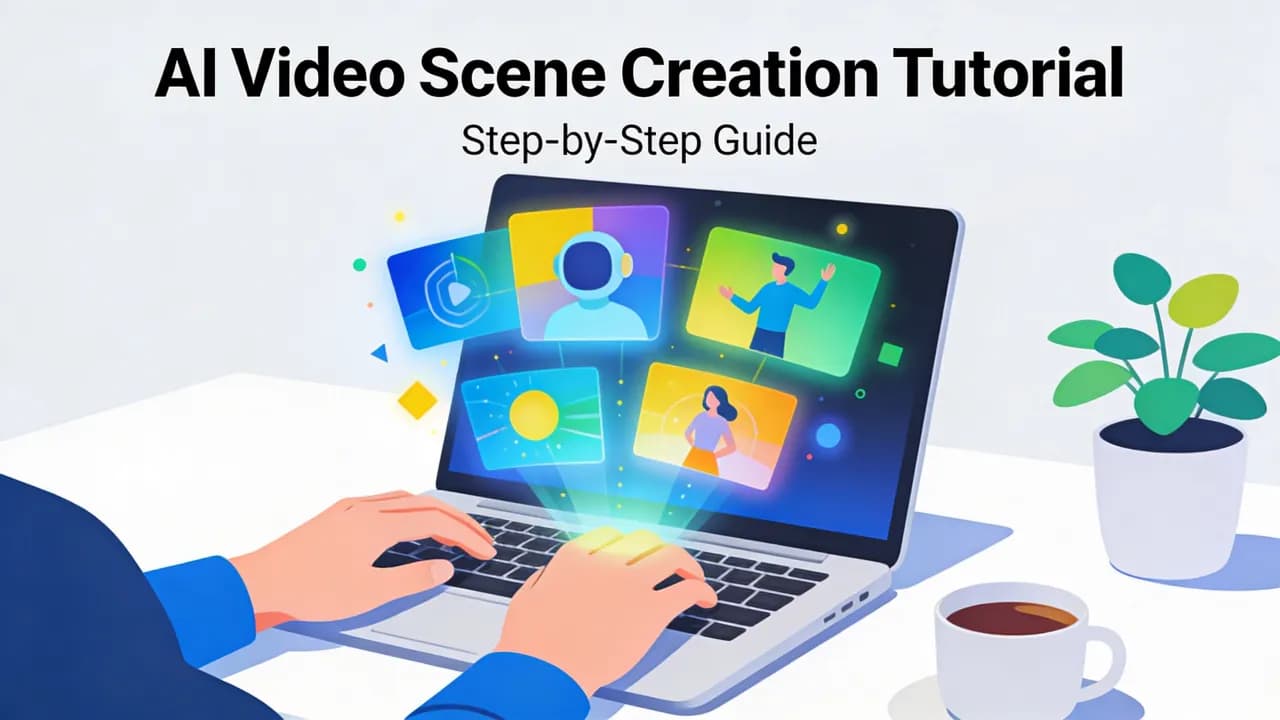
Making AI videos is no longer reserved for tech-savvy early adopters. The tools have matured to the point where anyone with a clear idea and a text prompt can produce professional-looking video content. This tutorial walks you through the entire process from planning your video to publishing the final cut, using AI at every stage.
By the end of this guide, you will have a concrete workflow you can repeat for any type of video, whether it is a YouTube explainer, a social media reel, a product demo, or a marketing ad.
Step 1: Define Your Video's Purpose
Before you open any tool, answer three questions: Who is this video for? What should the viewer do after watching? How long should it be? These answers shape every decision that follows, from prompt writing to music selection.
For example, a 60-second Instagram reel promoting a SaaS product has very different requirements than a 10-minute YouTube tutorial. The reel needs fast cuts, bold text overlays, and a hook in the first two seconds. The tutorial needs clear narration, screen recordings, and chapter markers.
Social media content: 15-60 seconds, vertical format, fast pacing, text overlays.
YouTube explainers: 5-15 minutes, horizontal format, structured narration, B-roll footage.
Product demos: 1-3 minutes, screen recording mixed with AI-generated visuals, clear call to action.
Ads and promos: 15-30 seconds, high-impact visuals, emotional hook, brand-consistent styling.
Step 2: Write Your Script
Even if your video is primarily visual, a script provides structure. Write out what the viewer should see and hear for each section of the video. If you are using AI voiceover, the script becomes the narration. If the video is music-driven, the script serves as a shot list.
Keep your script concise. A general rule is that 150 words of narration equals roughly one minute of video. For a 60-second reel, you need about 150 words. For a 5-minute explainer, aim for 750 words.
Step 3: Generate Your Video Clips
This is where text-to-video AI does the heavy lifting. Take each scene from your script and convert it into a prompt. The more specific your prompt, the better the output. If you need guidance on writing effective prompts, our complete text-to-video AI guide covers prompt engineering in depth.
Writing Effective Prompts
A good prompt includes four elements: the subject, the setting, the camera angle, and the visual style. Here is an example:
"Medium shot of a woman working on a laptop in a modern coworking space, natural window light, shallow depth of field, cinematic color grading, slow dolly forward."
Compare that to a weak prompt like "woman on laptop" which gives the model almost no guidance and will produce generic, uninteresting results.
Generating Multiple Takes
AI video generation is not deterministic. The same prompt will produce different results each time. Generate three to five variations of each scene and pick the best one. This is analogous to shooting multiple takes on a traditional set. The time cost is minimal since generation takes seconds, not hours.
Create videos like this with AI
Script, voiceover, images and subtitles — automated in minutes.
Step 4: Assemble and Edit
Once you have generated clips for each scene, bring them into an editor. If you are using Vexub, you can do this in the same platform where you generated the clips. Otherwise, export your clips and import them into your preferred editing tool.
Here is a practical editing checklist:
Trim and arrange: Place clips on the timeline in script order. Trim the start and end of each clip to remove any initial noise or abrupt endings.
Add transitions: Use simple cuts or cross-dissolves between scenes. Avoid flashy transitions unless they match your brand style.
Layer narration or music: Add your AI voiceover or background music track. Adjust audio levels so narration is clear and music sits underneath without competing.
Add subtitles: Subtitles are essential for social media where most viewers watch without sound. Use auto-captioning tools to generate them, then proofread for accuracy.
Include text overlays: Add key points, statistics, or calls to action as text overlays at relevant moments in the video.
Step 5: Review and Refine
Watch your assembled video from start to finish with fresh eyes. Check for these common issues:
Are there any jarring visual jumps between AI-generated clips? If so, add a brief transition or regenerate a clip with a more similar composition.
Is the pacing too fast or too slow? Adjust clip durations and add pauses where the viewer needs time to absorb information.
Does the narration sync with the visuals? Shift clips or adjust timing so that what the viewer sees matches what they hear.
Is the audio mix balanced? Music should enhance the mood without drowning out spoken words.
Step 6: Export and Publish
Export your video in the format required by your target platform. For most use cases:
YouTube: 1920x1080 or 3840x2160, MP4, H.264 or H.265 codec, 16:9 aspect ratio.
Instagram Reels and TikTok: 1080x1920, MP4, 9:16 aspect ratio, under 90 seconds for best reach.
LinkedIn and X: 1920x1080, MP4, 16:9, keep under 2 minutes for engagement.
Add a compelling thumbnail, write a description optimized for search, and include relevant hashtags. If you are looking for content inspiration, our list of 50 AI video content ideas covers topics across multiple niches.
Common Mistakes to Avoid
Over-relying on AI: AI-generated footage is a starting point, not the final product. Always review, edit, and refine. The best AI videos have a human editor making creative decisions.
Ignoring audio: Video with poor audio quality or no narration feels incomplete. Invest time in your audio track even if the visuals are AI-generated.
Skipping subtitles: Up to 85% of social media video is watched on mute. Subtitles are not optional for reach and accessibility.
Publishing without review: AI can generate unexpected artifacts, distorted faces, or inappropriate content. Always watch the full video before publishing.
Start Creating
The workflow above works for any type of AI video, from quick social posts to polished marketing campaigns. The key is iteration. Your first video will not be perfect, and that is fine. Each project teaches you what prompts work, what pacing feels right, and how to use the tools more effectively.
If you are new to video editing in general, our AI video editing for beginners guide covers the editing fundamentals you will need to get comfortable with timelines, cuts, and audio mixing.