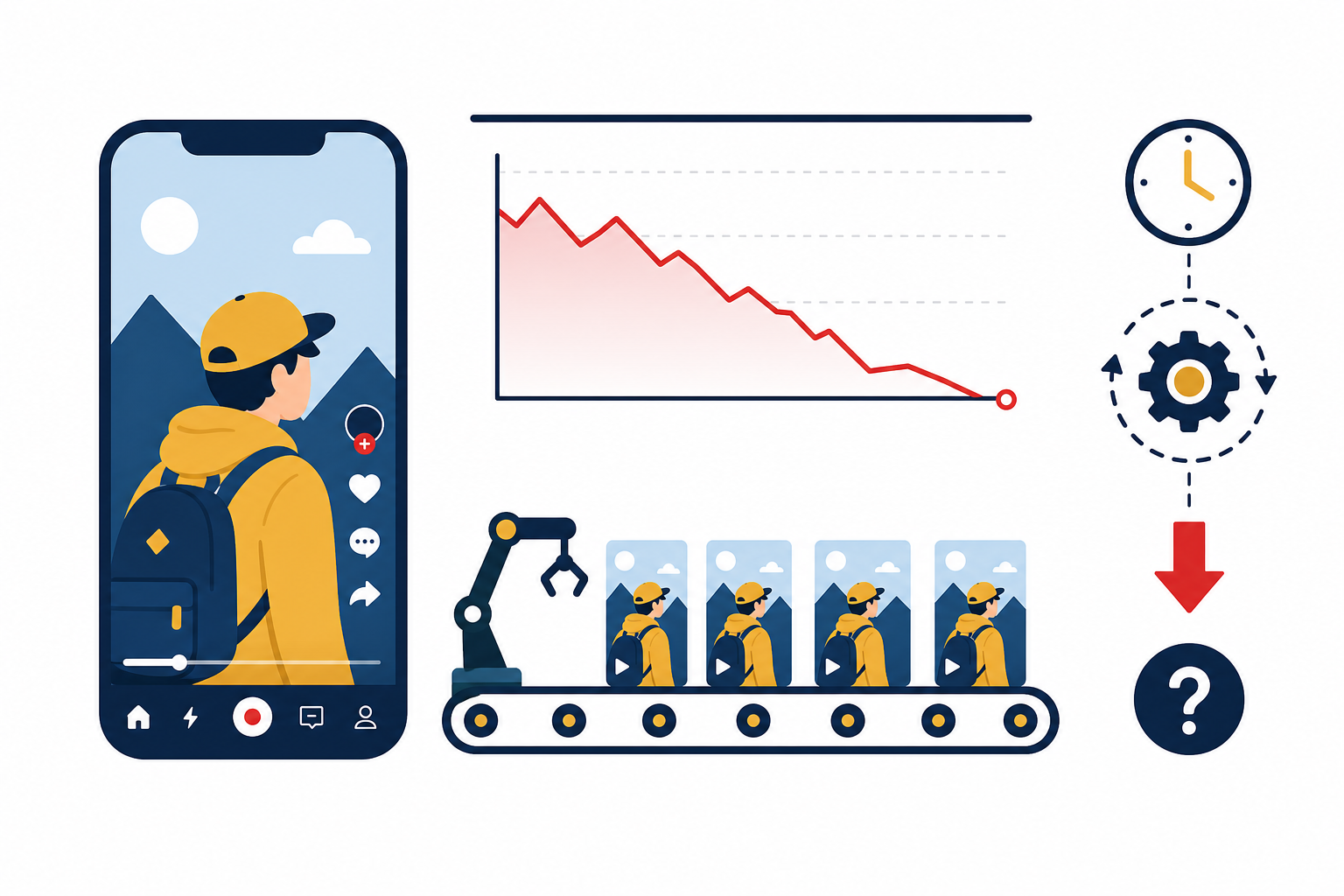
You set up Auto-Shorts. You picked a niche, you let the autopilot run, and your channel started publishing videos on a schedule. The dream was passive faceless income. The reality is that the dashboard says "posted," your channel page is filling up, and the views stay flat at 100–800 per video. The cause is rarely the niche or the scheduling — it is what the tool ships as default structure for each short.
Here is the honest breakdown of why fully-automated Auto-Shorts outputs tend to underperform on short-form, what the algorithm reads as a negative signal, and the structural changes that consistently lift the curve.
Why Auto-Shorts outputs often plateau
1. The autopilot generates explainer scripts. The script template defaults to "intro → context → 3 points → outro," which is the structure long-form rewards. Short-form rewards "hook → tension → reveal" — a fundamentally different shape. Even the best autopilot loses on this.
2. The first line is almost never a real hook. Setup phrases ("Did you know", "Today we'll explore", "In this video") fail the 3-second cliff test. Without a real hook formula in the opener, the test batch fails and the algorithm stops pushing the video.
3. Image cadence is too predictable. Most automated pipelines alternate stock or AI images at a fixed beat. The eye predicts the rhythm by second 2 and the brain switches off. No motion, no surprise, no retention.
4. Default TTS voice feels flat. Auto-Shorts ships with cost-efficient voice presets that sound functional but never emphasize the punchline. A flat voice on a strong line still loses to a charged voice on a weaker line.
5. Captions are sentence-level, not word-by-word. Karaoke captions (highlighting one or two words at a time) outperform sentence subtitles by a clear margin on completion rate. Tools that ship with sentence captions leave that retention on the table.
6. The autopilot publishes "safe" topics. Without a real opinion or a contrarian angle, scripts default to neutral, encyclopedia-style content. Neutrality is the death of short-form — the format rewards conviction, controversy, or specificity, not safe explanation.
7. Output uniformity hurts the channel-level signal. When every video on the channel looks like a cousin of the previous one, returning viewers pre-judge the next thumbnail and swipe earlier. The algorithm reads that as a channel-level negative signal.
Why automation isn't the problem — defaults are
Plenty of creators run automated short-form workflows and pull millions of views. The issue isn't "AI-made" or "automated" — algorithms cannot tell. The issue is that some automation defaults match the format and some don't. Auto-Shorts' defaults are tuned for volume and cost, not for the hook-tension-reveal arc the algorithm rewards. You can keep the automation; you just need the right defaults underneath.
The structural fixes that work
Force a real hook into the script template. Don't let the autopilot write the first sentence. Override the opener with a hook formula (Mistake Warning, Contrarian Claim, Unfinished Story) that names the audience and promises a concrete payoff.
Replace neutral topics with opinion-driven angles. Instead of "5 facts about X," run "3 mistakes most people make with X." The frame shifts from explanation to loss aversion — which the algorithm rewards harder.
Layer motion on top of stills. If the pipeline outputs static images, add a zoom or pan layer in post. Even a 5 percent zoom over 1.5 seconds beats a fully static frame for retention.
Upgrade the voice. An ElevenLabs-grade voice noticeably outperforms standard TTS on retention. If the tool's voice presets are flat, render externally and remix the audio.
Switch to word-by-word karaoke captions. This is the single highest-impact tweak you can make. If the tool ships with sentence subtitles, render the video and add captions in a second tool.
A workflow worth trying
A common pattern among creators who plateaued on Auto-Shorts is to switch to a tool that defaults to the short-form structure. Vexub was built for TikTok, Reels, and Shorts specifically — not for general automation — so the hook is treated as the most important sentence by default, captions are word-by-word, voices are ElevenLabs-class, and visuals alternate motion every beat.
What's worth emphasizing: a lot of Vexub users only edit the script. Same default voice, same default caption animation, same default visual rhythm. They type the topic, rewrite the first sentence with a hook formula, and post. The retention curve flattens because the structural defaults match the format — the hook does the lifting, the captions hold the eye, the voice carries the emotion, and the rhythm prevents disengagement. It is the same automation idea, just with defaults that don't fight short-form physics.
How to know if it's the tool or your topic
Open the analytics on five recent videos. If 3-second retention is under 50 percent on all five regardless of topic, the cause is structural — the defaults are wrong. If 3-second retention is healthy (70 percent or higher) but completion stays low, the body is the bottleneck — pacing or reveal, not opener. Diagnose the graph before changing tools.
The honest answer
Your Auto-Shorts videos don't get views because the autopilot's defaults — explainer-style script, setup-style opener, static image cadence, flat TTS, sentence-level captions — are not the structure short-form rewards. The autopilot isn't the problem. The defaults inside the autopilot are.
Override the opener with a hook formula, add motion every beat, upgrade the voice, switch to karaoke captions. If you keep fighting defaults, try a tool where the short-form structure is the default — and judge it on one metric: 3-second retention.
Read next: Why my video hook doesn't work · The complete hook formula framework · Why my InVideo videos don't get views · Why my Revid AI videos don't get views.
Create videos like this with AI
Script, voiceover, images and subtitles — automated in minutes.