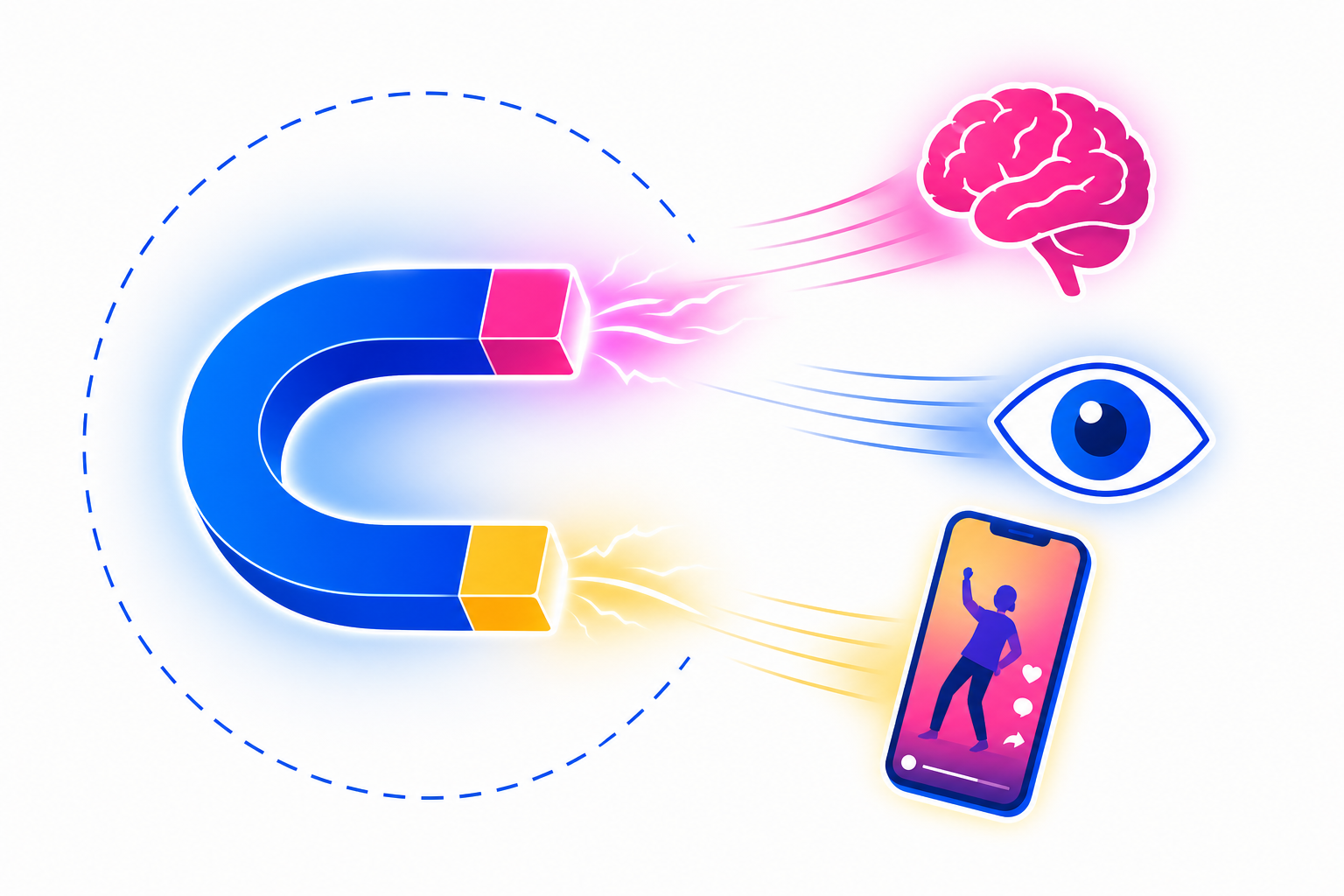
The hook is the single most important sentence in a short-form video. Yet most creators write it last, treat it as a throwaway intro, or rely on inspiration. The viral creators do the opposite: they obsess over the opener and rely on a system called the hook formula — a repeatable, plug-and-play structure that reliably stops the scroll.
This guide is the complete framework. You will learn what a hook formula actually is, the four cognitive triggers that make every viral hook work, the three-part anatomy you can apply to any topic, 40 ready-to-use templates, a 5-criteria scorecard to evaluate hooks before publishing, and a testing methodology to iterate on the data.
If you watch your first three seconds carefully and apply even half of what is in this guide, your average retention should climb noticeably within two to three weeks of posting.
What Is a Hook Formula?
A hook formula is a repeatable sentence structure that reliably captures attention in the first one to three seconds of a video. Think of it as a recipe: the ingredients (your niche, your offer, your story) change every time, but the underlying pattern stays the same. The formula does the heavy psychological lifting; you just plug in the specifics.
A hook is not a topic, not a thumbnail, not a thesis. It is the exact words and visual that play in the moment a viewer's thumb pauses. That moment lasts roughly the length of a held breath. A hook formula is the system that lets you write something effective in that window, on demand, every time you sit down to record.
The 3-Second Rule: Why a Hook Formula Matters
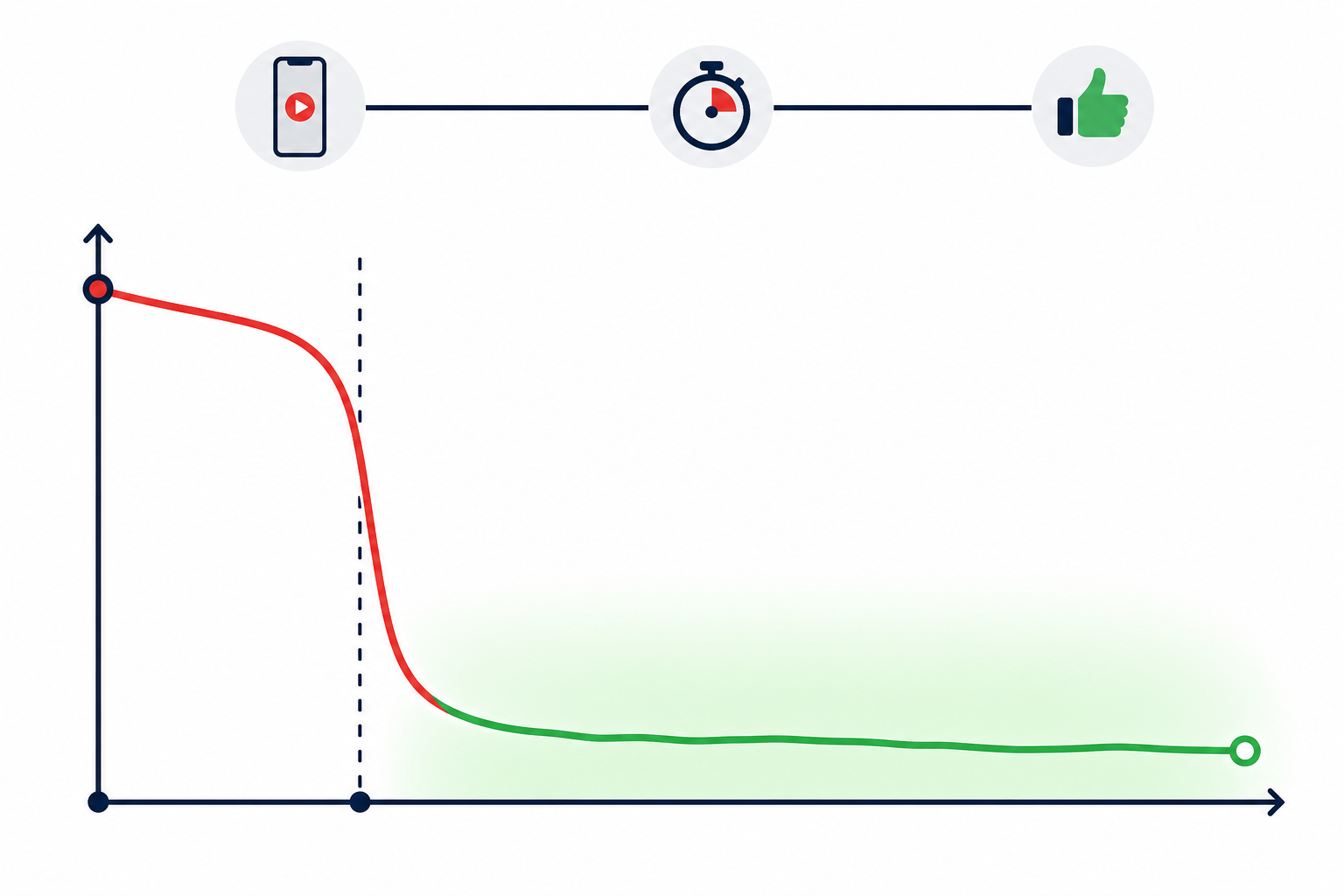
Every short-form platform — TikTok, Instagram Reels, YouTube Shorts — ranks content by retention. The cliff happens at the three-second mark: if a large share of viewers drop off before then, the algorithm interprets the signal as negative and limits distribution. If retention holds past three seconds, the video is pushed to more feeds and the curve compounds.
Three seconds is roughly 10 to 14 spoken words. That is the entire budget a hook formula has to work with. There is no time for context, no time for a slow build, no time for niceties. The opener has to fire a cognitive trigger and plant a reason to stay — all before the viewer's thumb reaches the next video.
The 4 Cognitive Triggers Behind Every Viral Hook Formula
Every hook formula that has ever gone viral does so because it activates at least one of four cognitive triggers. Knowing the triggers lets you reverse-engineer any viral hook and write your own version on demand.
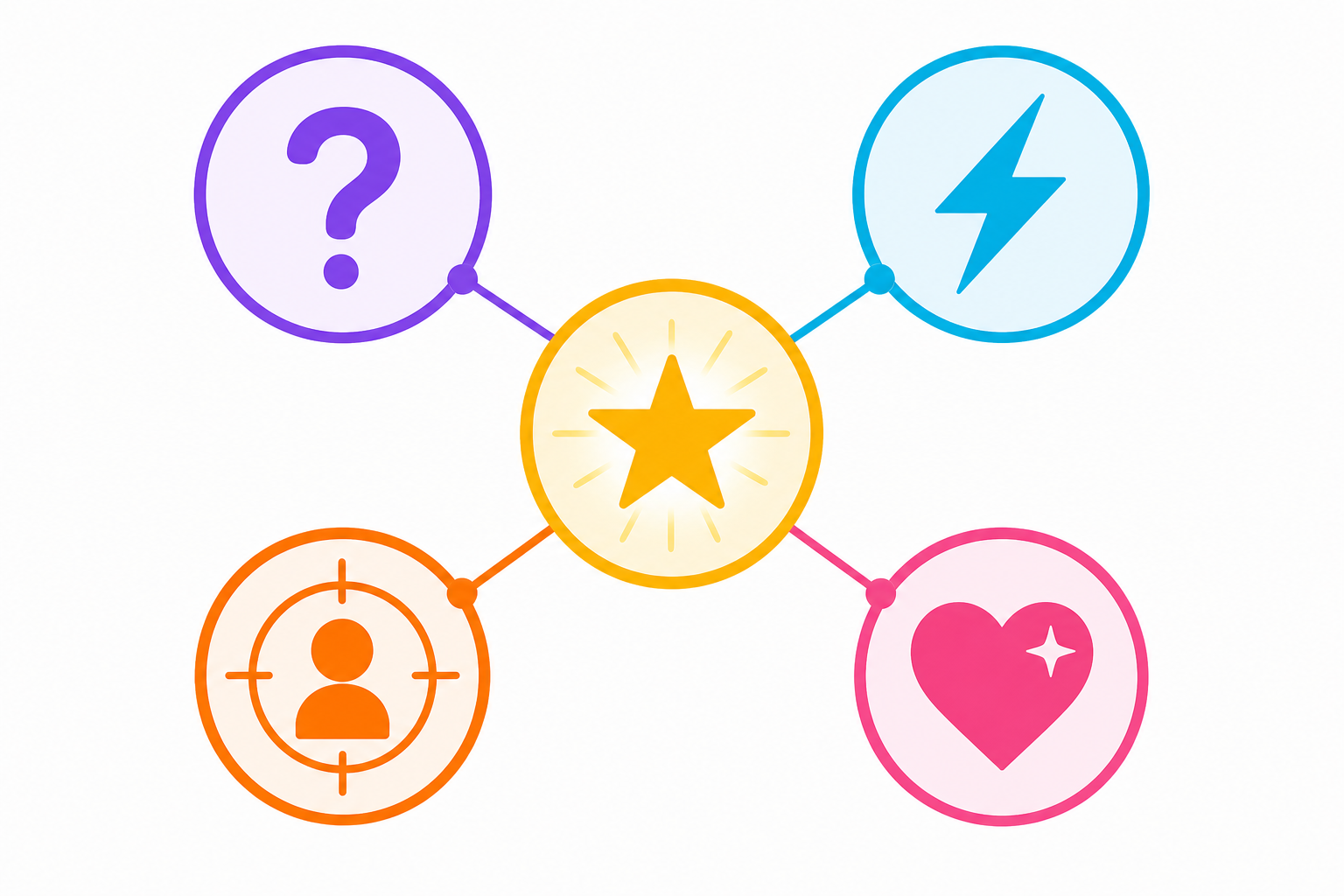
Trigger 1 — Curiosity Gap
The brain hates open loops. When you state an incomplete fact — a question without an answer, a story without an ending, a claim without proof — your viewer experiences mild cognitive discomfort and stays to resolve it. The curiosity gap is the most reliable trigger in the entire framework.
Trigger 2 — Pattern Interrupt
Scrolling is hypnotic. A sudden change in audio, a jarring visual, an unexpected first word forces the brain to re-engage. Pattern interrupts are why hooks that open with a bold claim, an unusual image, or a physical action consistently outperform calm openers.
Trigger 3 — Self-Relevance
People pay attention to content they believe is about them. A hook that names the audience, the pain, or the desire instantly feels personal — and personal content gets watched. "If you're a freelancer in month two" outperforms "if you're new" by a wide margin.
Trigger 4 — Emotional Arousal
Surprise, anger, awe, fear, and excitement all spike attention. Hooks that prime an emotion in the first second — through tone, music, or a charged phrase — pull retention up immediately. This is why polarizing takes and dramatic reveals dominate short-form feeds.
The strongest hook formulas stack two or more triggers in a single sentence. That is what separates a hook that earns 70 percent retention from one that loses half the audience before the second second.
The H-A-P Framework: Anatomy of Any Hook Formula
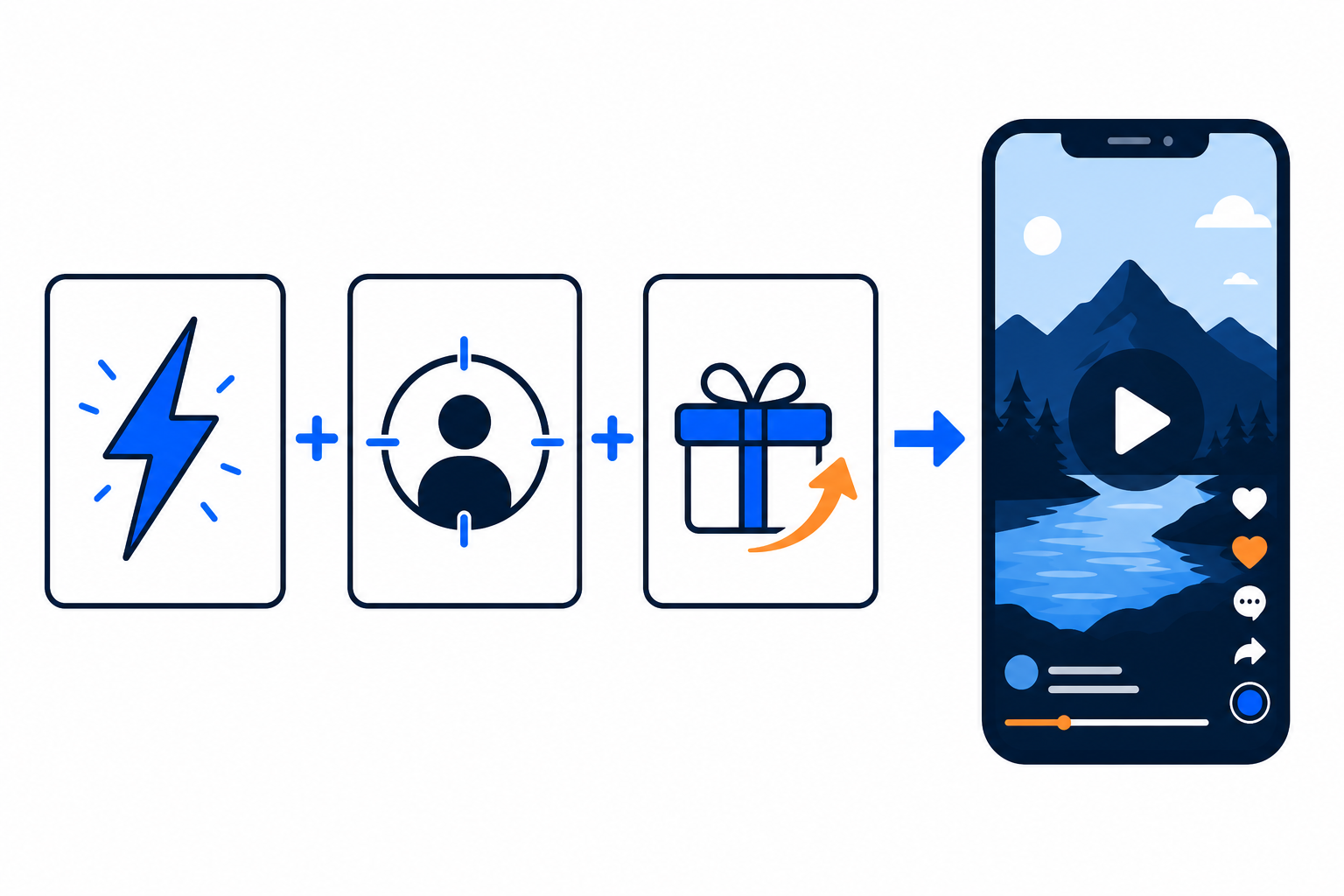
Every effective hook formula can be decomposed into three components. Master the three and you can write a hook for any video in under 60 seconds.
H — Hook word or pattern interrupt
The very first beat: a word, image, or sound that forces the brain to engage. "Stop", "Never", "Imagine", a physical action on camera, a bold caption appearing in frame. Without H, the brain stays in scroll mode and the rest of the hook never lands.
A — Audience call-out
The specific person who should feel addressed. "Freelancers" is okay; "freelancers who keep losing clients in month two" is far stronger. The more specific the call-out, the higher the self-relevance trigger fires for the right viewer and the lower the bounce from the wrong viewer.
P — Promise or curiosity payload
The reason to stay. A concrete outcome, a secret, a surprising fact, or an open story loop. Vague promises kill retention. Replace "good results" with "3 booked calls per week." Replace "a tip" with "the exact line that doubled my reply rate."
Trigger Stacking: Combining Triggers for Maximum Impact
Single-trigger hooks work. Multi-trigger hooks dominate. The exercise is to look at every hook draft and ask: which of the four triggers does this fire? If the answer is only one, rewrite until you stack at least two.
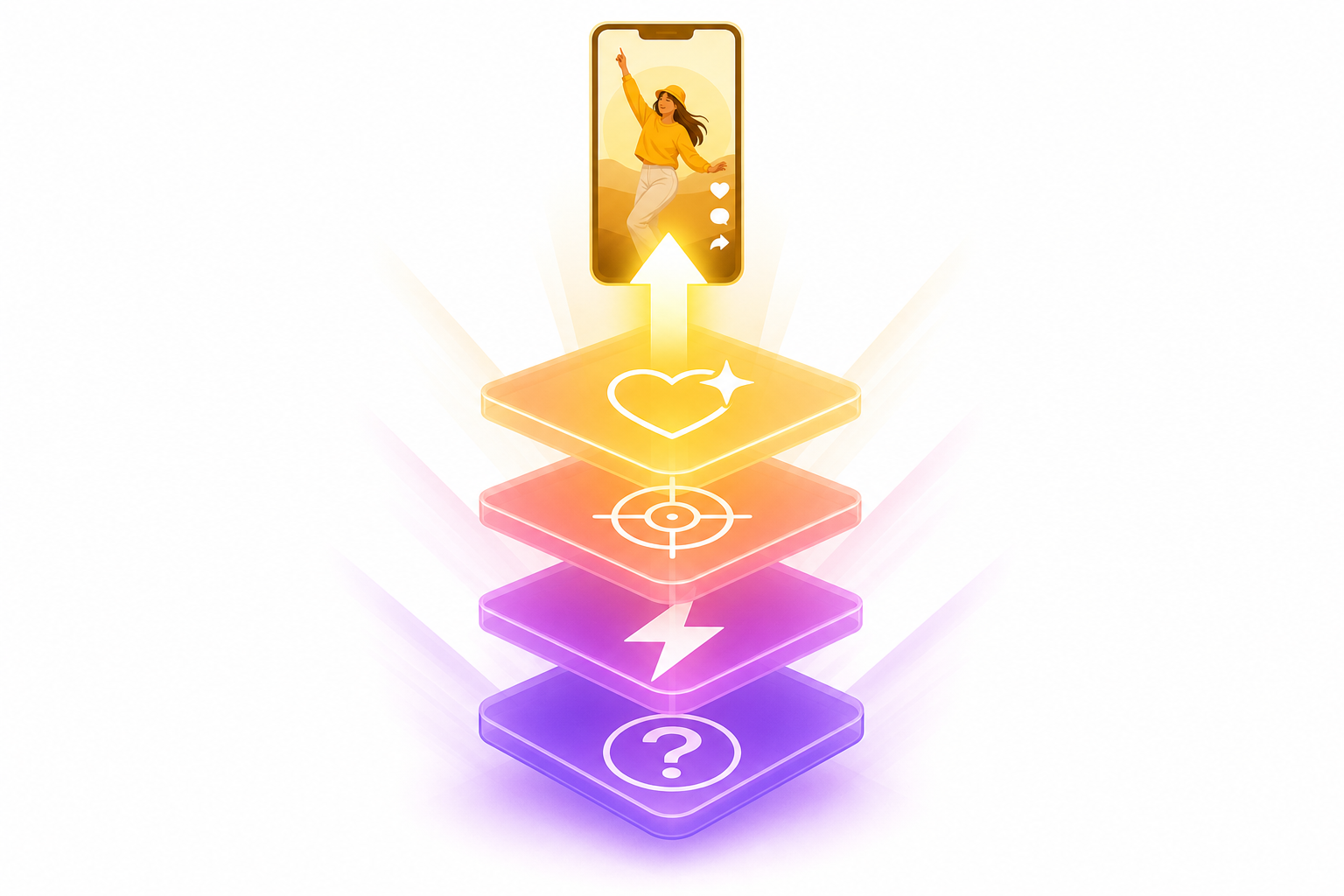
Curiosity + Self-Relevance: "If you're a freelancer with under 5 clients, here's the contract clause you're missing." Audience-specific + open loop.
Pattern Interrupt + Emotion: "Burn your old resume — here's what actually gets you hired in 2026." Visual action + emotional charge.
Curiosity + Authority: "After auditing 200 cold emails, this is the one line that doubles reply rates." Open loop + credibility.
All four: "Stop doing 100 push-ups a day if you're over 30 — this 12-minute routine builds twice the muscle." H (stop), A (over 30), P (12-min, 2x muscle), emotion (loss aversion). The strongest hooks fire on all four.
40 Hook Formulas, Organized by Trigger
Every formula below is a copy-paste template. Read the structure, then read the example. Most viral creators rotate through 5 to 10 formulas they have personally tested — pick the ones that match your voice and start there.
Curiosity Formulas (10)
1. The Contrarian Claim — "Everything you know about [topic] is wrong." Example: "Everything you know about morning routines is wrong — and the science is going to surprise you."
2. The Unfinished Story — "I almost [bad outcome] until I discovered this one thing." Example: "I almost quit freelancing six months in, until I changed one line in my client emails."
3. The Secret Reveal — "Here's what [insiders] don't want you to know about [topic]." Example: "Here's what nutritionists won't tell you about meal replacement shakes."
4. The Countdown Tease — "Number one literally changed my life." Example: "Five habits that doubled my income — number four was the one I resisted the longest."
5. The Impossible Result — "I [extreme outcome] in [short timeframe] doing this." Example: "I grew from 0 to 100K followers in 30 days posting one type of video."
6. The Cliffhanger Question — "What if I told you [unexpected claim]?" Example: "What if I told you the most productive hour of your day is the one you spend doing nothing?"
7. The Number Drop — "There are [N] reasons [outcome] — and most people only know one." Example: "There are seven reasons your videos plateau at 1,000 views — and most creators only know one."
8. The Reverse Reveal — "The reason [outcome] isn't [common belief] — it's this." Example: "The reason your sleep is bad isn't caffeine — it's the lighting in your bedroom."
9. The Origin Question — "Why does [X common thing] exist? The answer is wild." Example: "Why does every keyboard start with QWERTY? The answer involves a 19th-century lawsuit."
10. The Forbidden Tease — "I shouldn't be sharing this, but…" Example: "I shouldn't be sharing this, but this is the exact ad copy that did 7 figures last quarter."
Create videos like this with AI
Script, voiceover, images and subtitles — automated in minutes.
Authority Formulas (8)
11. The Credential Lead — "As a [profession] with [X] years of experience, here's my take on [topic]." Example: "As a UX designer with 8 years at 3 startups, here's why most landing pages convert under 2 percent."
12. The Social Proof Opener — "This strategy helped [N] of my [audience] do [result]." Example: "This single email script booked 47 sales calls for my clients last month."
13. The Myth Buster — "Stop doing [common practice] — here's what actually works." Example: "Stop tracking macros if you want to lose fat — here's what to track instead."
14. The Behind-the-Scenes — "Let me show you how I actually [process]." Example: "Let me show you the spreadsheet I use to plan a full month of content in two hours."
15. The Data Drop — "After analyzing [N] [things], here's the pattern nobody talks about." Example: "After analyzing 200 viral TikTok hooks, here's the pattern nobody talks about."
16. The Failure Resume — "I failed at [X] [N] times before figuring out this one thing." Example: "I failed at launching a course four times before figuring out the one pricing change that made it work."
17. The Cost Reveal — "I spent $[X] learning this so you don't have to." Example: "I spent $12,000 on courses about cold email — here's the only thing that actually mattered."
18. The Insider Position — "After [N] years inside [industry], here's the [unspoken rule]." Example: "After 6 years inside a recruiting agency, here's the unspoken rule about resume length."
Emotion Formulas (8)
19. The Empathy Hook — "If you're struggling with [problem], this is for you." Example: "If you keep starting projects you never finish, this is for you."
20. The Fear of Missing Out — "Everyone is doing this except you." Example: "Every freelancer making over six figures is doing this — and most beginners ignore it."
21. The Relatable Frustration — "Why does nobody talk about [annoying thing]?" Example: "Why does nobody talk about how exhausting it is to work from a coffee shop every day?"
22. The Aspiration Hook — "Imagine waking up and [dream scenario]." Example: "Imagine waking up and seeing 12 new clients booked overnight without sending a single DM."
23. The Confession — "I'm going to admit something I've never told anyone." Example: "I'm going to admit something I've never told anyone — I almost shut down my agency last December."
24. The Polarizer — "You're going to either love or hate this." Example: "You're going to either love or hate this take on productivity systems — but the data is on my side."
25. The Public Shame — "This is what nobody tells you about [aspirational topic]." Example: "This is what nobody tells you about quitting your 9-to-5 — the first three months are brutal."
26. The Wake-Up Call — "If [bad scenario] is happening to you, it's not your fault — but here's how to fix it." Example: "If your videos keep flopping, it's not the algorithm punishing you — here's the actual reason."
Tactical / Direct Formulas (8)
27. The How-To Promise — "Here's exactly how to [achieve result] in [timeframe]." Example: "Here's exactly how to write a cold email that gets a reply in under three minutes."
28. The Mistake Warning — "Stop making this mistake with your [topic]." Example: "Stop making this mistake with your TikTok captions — it's why your videos plateau at 1,000 views."
29. The Tool Reveal — "This free tool does what I used to pay $[X]/month for." Example: "This free tool does what I used to pay 200 dollars a month for — and it takes 30 seconds to set up."
30. The One-Liner Hack — "Add this one line to your [thing] and [result]." Example: "Add this one line to your landing page and watch sign-ups double."
31. The Cheat Sheet — "Save this before the algorithm hides it." Example: "Save this checklist before the algorithm hides it — five hooks for any short-form video."
32. The Daily Habit — "Do this for [N] days and [outcome]." Example: "Do this for 14 days and your sleep score will jump 20 points."
33. The Comparison — "[Option A] vs [Option B]: here's which one actually wins." Example: "ChatGPT vs Claude for cold email — here's which one actually wins on reply rate."
34. The Step Tease — "Step [N] is the one most people skip — and it's the most important." Example: "Step three is the one most people skip — and it's the most important if you want your hook to land."
Engagement Bait Formulas (6)
35. The Hot Take — "Unpopular opinion: [bold statement]." Example: "Unpopular opinion: most productivity advice is designed for people who already have time."
36. The Challenge — "I bet you can't watch this without [reaction]." Example: "I bet you can't watch this without pausing and writing down at least one of these."
37. The Question Hook — "What would you do if [scenario]?" Example: "What would you do if you lost your top client tomorrow? Here's my exact backup plan."
38. The List Tease — "[N] [things] you wish you knew before [milestone]." Example: "Seven things you wish you knew before launching your first online course."
39. The Quote Drop — "[Authority] once said [shocking line] — and they were right." Example: "Naval once said the richest people in the world look for a problem they want to solve, not a job they want to do — and the data backs him up."
40. The Pattern Break Visual — Open with an unexpected on-screen action: breaking, pouring, dropping, ripping. Example: rip a printed resume on camera, voice-over: "This is what I tell every applicant to do before sending the next one."
Hook Formula Examples by Niche
Formulas are universal, but the way you phrase them depends on the audience. Below are ready-to-adapt hook examples mapped to the most common short-form niches. Use them as a starting point and rewrite in your own voice.
Fitness & Health
Myth Buster (#13): "Stop doing 100 crunches a day — here's the one ab exercise that actually flattens your stomach."
Aspiration (#22): "Imagine waking up at 6 a.m. with more energy than your morning coffee gives you."
Impossible Result (#5): "I lost 12 pounds in 8 weeks without giving up bread — here's the exact split."
Business, Freelance & Money
Social Proof (#12): "This cold-email template booked 47 sales calls for my clients last month."
Mistake Warning (#28): "Stop quoting hourly rates — here's why my freelance income tripled when I switched to value-based pricing."
Hot Take (#35): "Unpopular opinion: building in public is overrated for most solo founders."
Education & Productivity
How-To Promise (#27): "Here's exactly how to read 30 books a year without speed-reading."
Tool Reveal (#29): "This free Notion template replaced four apps I used to pay for."
List Tease (#38): "Five study techniques backed by neuroscience — number three I wish I learned in school."
Lifestyle, Travel & Personal Brand
Confession (#23): "I'm going to admit something I've never told anyone about my year of solo travel."
Behind-the-Scenes (#14): "Let me show you what one week in Lisbon actually costs in 2026."
Cliffhanger Question (#6): "What if the cheapest country I visited this year was also the most luxurious?"
Faceless & AI Content
Contrarian Claim (#1): "Everything you know about faceless YouTube is wrong — the new playbook takes 90 minutes a week."
Secret Reveal (#3): "Here's how AI creators are pulling 500K views per video without ever showing their face."
If you run a faceless channel, plug these hooks into the workflow described in our guide on faceless TikTok content for 2026.
Tech, SaaS & Indie Hacking
Failure Resume (#16): "I shipped four failed SaaS products before realizing the one mistake that killed every launch."
Comparison (#33): "Stripe vs Lemon Squeezy for solo founders — here's which one actually wins after the first $10K MRR."
Real Estate & Investing
Insider Position (#18): "After 6 years closing deals in this market, here's the unspoken rule about negotiating before October."
Number Drop (#7): "There are five reasons your first rental property fails — and most landlords only know one."
Visual Hook Formulas (No Spoken Word Required)
Not every hook is verbal. Some of the highest-retention openers on TikTok and Reels rely entirely on what the eye sees in the first frame. A spoken hook formula stacks on top of a visual one for even stronger results.
Action Disruption: Begin mid-action — pouring, ripping, smashing, throwing. Motion in frame one beats stillness every time.
Big-Number Caption: Open with a giant on-screen number ("$47,200 in 90 days"). The eye locks onto numerals before words.
Visual Mismatch: Pair an unexpected image with a calm voice (a chef in a tuxedo, a CEO in pajamas). The cognitive dissonance forces attention.
Direct Eye Contact: Stare straight into the lens for two seconds before speaking. Holds the viewer biologically, then deliver the verbal hook.
Frame-1 Result: Show the end result first (the finished cake, the muscular transformation, the dashboard with 100K). Then promise to walk back to how you got there.
How to Test and Iterate on Hook Formulas
Having a library of hook formulas is only the start. The real skill is testing which ones resonate with your specific audience. Here is a practical framework.
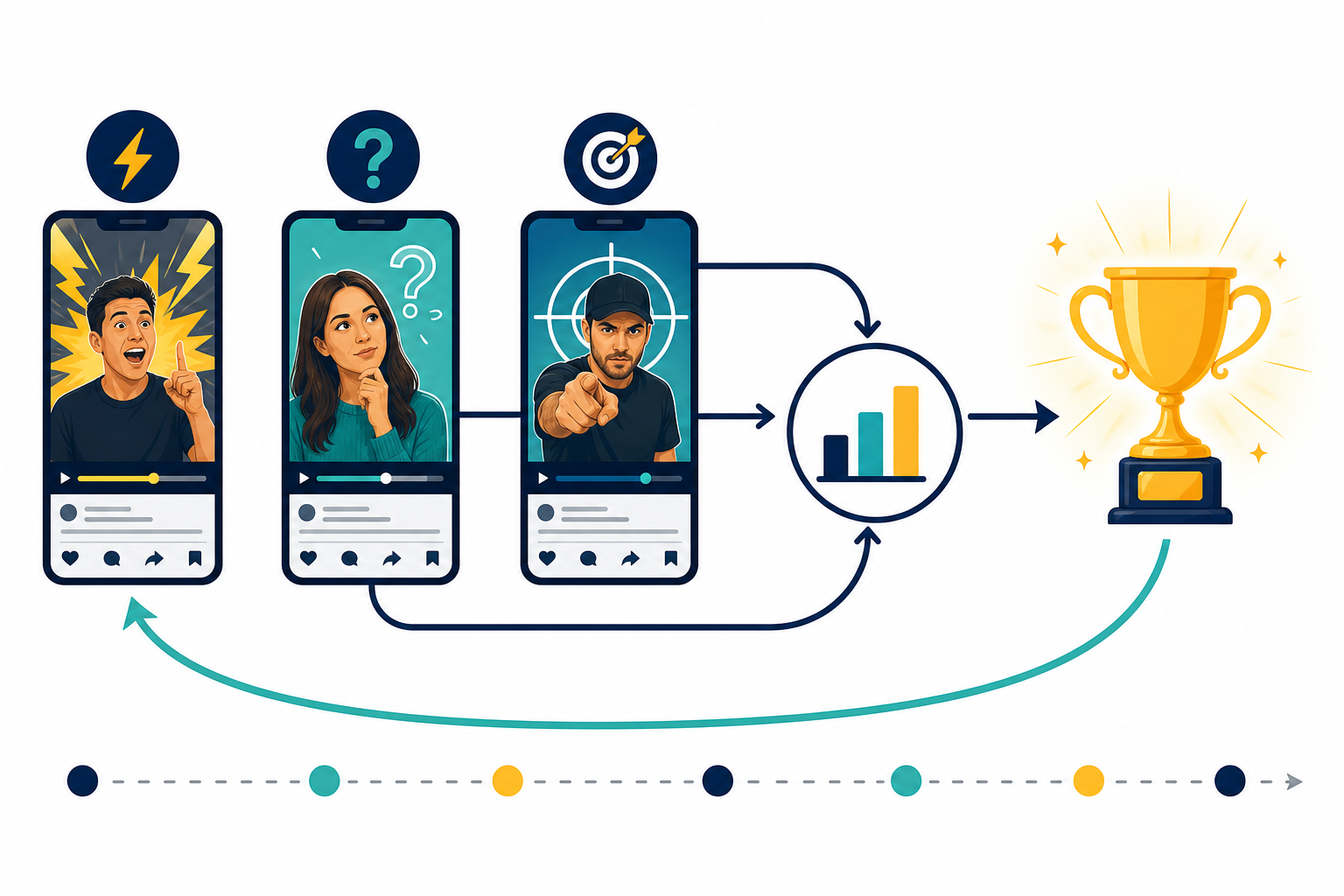
Step 1 — Generate 3 variants per video. For every script, write the same content with three different hook formulas from three different trigger categories (curiosity, authority, tactical).
Step 2 — Publish them spaced 3–4 days apart. Same caption, same hashtags, same posting time. Only the hook varies.
Step 3 — Compare retention at the 1s and 3s marks. If the biggest drop is at 1s, the hook needs a stronger pattern interrupt. If at 3s, the promise (P) is too weak.
Step 4 — Tag every video with its formula. Build a personal spreadsheet: hook formula number, retention at 3s, completion rate, total views. After 20 videos, the winning formulas reveal themselves.
Step 5 — Double down and rotate. Once you find two or three formulas that consistently outperform, make them the backbone of your content — but keep rotating in new variants to avoid audience fatigue.
If you are repurposing long-form content into short clips, hook testing becomes especially efficient — you already have the body of the video and only need to vary the first 3 seconds. The same logic is covered in A/B testing video thumbnails and titles.
The Hook Formula Scorecard
Before publishing any video, run the hook through this 5-criteria scorecard. Each criterion is binary — yes or no. A passing hook scores 4 or 5; anything 3 or below should be rewritten.
Trigger fire: Does the hook activate at least two of the four cognitive triggers (curiosity, pattern interrupt, self-relevance, emotion)?
Specific audience call-out: Is the audience named with enough specificity that the right viewer feels addressed within the first 3 seconds?
Concrete promise: Is the payoff specific (a number, a result, a secret)? Replace any vague benefit with a measurable one.
Word budget: Is the spoken hook under 14 words? If not, cut every word that does not contribute to a trigger, the call-out, or the promise.
Sensory layer: Does the visual or caption reinforce the hook in the same frame? An on-screen text mirror of the spoken hook compounds retention.
Common Hook Formula Mistakes
Burying the hook. Opening with "Today I want to talk about…" or "So a lot of people ask me…". The actual hook arrives at second 6, well past the cliff. Open with the formula; add context after.
Vague promises. "This will change your life" is a non-promise. Replace with a measurable, time-bound result.
Single-trigger hooks. Hooks that only fire curiosity (no audience call-out, no emotion) consistently underperform stacked hooks.
Using the same formula every time. Viewers recognize your pattern and start skipping. Rotate at least 5 formulas.
Soft visuals on a strong verbal hook. A great spoken hook on a static talking-head shot loses to a mediocre hook with a pattern-break visual. Match the energy.
Generating hooks with AI and shipping them raw. AI defaults to safe phrasing. Use AI for volume (20 variants in seconds), but rewrite every shipped hook through the H-A-P framework.
Frequently Asked Questions
What is the best hook formula for short-form video?
There is no single best formula — top creators rotate between five and ten. The three most consistently viral across niches in 2026 are the Contrarian Claim (#1), the Mistake Warning (#28), and the List Tease (#38), because each one stacks curiosity, self-relevance, and a clear promise.
How long should a hook be?
Spoken hooks should land within the first 3 seconds, which is 10 to 14 words. Visual hooks should hit in the first frame. Anything longer and you forfeit the algorithmic boost tied to the early-retention signal.
Do hook formulas still work in 2026 or has the audience caught on?
Formulas still work because they are based on cognitive triggers, not surface novelty. Viewers may recognize a template, but the brain still responds to a curiosity gap or a self-relevant call-out. Refresh the surface phrasing every few months; the structure stays evergreen.
Can I use the same hook formula every video?
No. Repeating one formula trains your audience to anticipate and skip. Rotate 5 to 10 tested formulas, and match the formula to the content type: tactical content pairs with How-To Promise (#27), story content with Unfinished Story (#2), opinion content with Hot Take (#35).
Can AI write good hooks?
AI is excellent for generating dozens of variations once you give it a formula and a clear audience description. The trap is letting AI choose the angle — it defaults to generic phrasing. Use AI for volume, then edit ruthlessly through the H-A-P framework. Vexub's AI video generator automates the full script-to-video pipeline so you can run rapid hook experiments without re-filming.
Hook formula vs. hook idea — what's the difference?
A hook idea is a one-off line you happened to think of. A hook formula is a repeatable structure you can apply to any video forever. Ideas depend on inspiration; formulas compound.
What is the biggest mistake creators make with hook formulas?
Burying the hook behind context. The opener has 3 seconds of attention to fire a trigger and plant a promise. Anything that delays that — a polite intro, a slow zoom-in, a logo splash — is silently destroying retention.
Should the on-screen caption match the spoken hook?
Yes. A spoken hook plus a mirrored caption compounds retention — the brain processes both audio and visual channels. Pair your hook with a strong subtitle preset for the highest completion rates.
Final Thoughts
A hook formula is not a trick — it is a system. The 40 templates in this guide give you the surface library; the H-A-P framework, the four-trigger model, and the scorecard give you the underlying engine. Use the templates to ship faster; use the framework to write your own.
Pick three formulas. Write five variants of each in your own voice. Run them against the scorecard. Ship them across your next batch of videos and let the retention data guide the next round. Within four weeks you will have a personalized library of hooks that consistently outperform the generic competition.
The scroll never stops. Your job is to make it pause — on demand, every time.