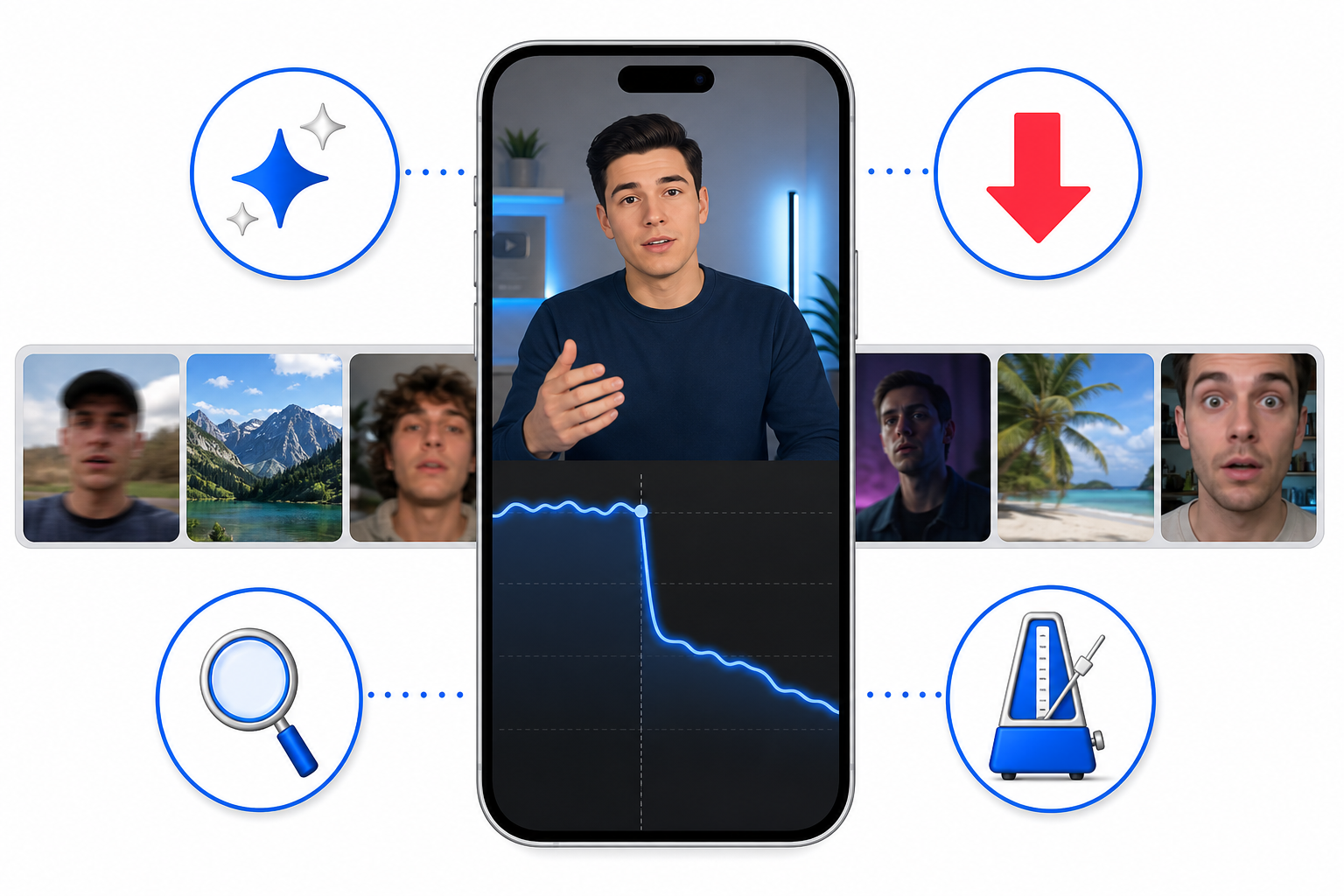
Short.ai produces a polished-looking vertical video in minutes. You typed a topic, picked a style, hit generate, and the output was clean enough to post. You posted it. Views plateaued under a thousand. You tried again, different angle, same result. The frustrating part is that the output looks professional on the preview screen. The retention graph tells a different story — and the cause is structural.
Here is the honest breakdown of why Short.ai outputs tend to underperform on short-form, what the algorithm is reading, and the structural changes that consistently lift the curve.
Why Short.ai outputs often plateau on short-form
1. Polish without retention. Short.ai outputs look professional, which is exactly the trap. The platform algorithms don't reward polish — they reward retention. A polished short with a weak hook loses to a rough short with a strong opener every single time.
2. The first line reads like an intro. Default scripts open with setup phrases that fail the 3-second cliff. Without a real hook formula forced into the opener, the test batch fails and distribution dies.
3. Image quality varies across segments. AI images can land beautifully on one segment and look generic or off-prompt on the next. The visual inconsistency breaks immersion and pushes viewers to swipe at the weak frame.
4. The voice often lacks emotional emphasis. Default TTS reads the words but doesn't lean into the punchline. A flat reading of a strong line still underperforms a charged reading of a weaker line.
5. Captions tend to be sentence-level. Karaoke captions (highlighting one or two words at a time) noticeably outperform sentence subtitles on completion rate. Tools that ship with sentence captions by default leave that retention on the table.
6. The pacing is too even. Most generated outputs spend roughly the same time per beat. Short-form rewards variable rhythm — fast-fast-slow, or slow-fast-fast — not a metronome. Even pacing is what makes a video feel "AI" even when the visuals are clean.
7. Hook templates feel repeated across the platform. When thousands of creators use the same generator, openers start sounding alike. Viewers who saw three Short.ai-style openers in their feed today will recognize the fourth and swipe earlier.
Why polish isn't the metric that matters
The biggest trap is judging an AI video tool by how the output looks. "Clean visuals" and "professional captions" feel reassuring, but they are not what the algorithm scores. The algorithm scores retention at second 1, second 3, second 10, and completion rate. A clean-looking video with a 35 percent 3-second retention is a worse short than an ugly-looking video with 70 percent.
Judge any short-form tool on retention only. If you can't see the 3-second and completion-rate numbers improve across 10 videos, the polish doesn't matter.
The structural fixes that work
Override the opener manually. Don't accept the first sentence the generator produces. Replace it with a tested hook formula — Mistake Warning, Contrarian Claim, Unfinished Story — built with the H-A-P framework (hook word, audience call-out, concrete promise).
Audit each image segment. If one of the 6–10 images in the short looks off-prompt, regenerate just that beat. A single bad frame kills retention faster than a slightly weaker hook.
Add rhythmic variation. Cut short on the punchline, hold longer on the reveal. Variable pacing is what makes a short feel intentional rather than generated.
Upgrade the voice. ElevenLabs-class voices outperform default TTS noticeably. The voice is the emotional carrier — don't accept a flat one.
Switch to word-by-word karaoke captions. Highest-impact tweak. If the tool ships with sentence-level subtitles, render and re-caption in a second tool — the retention boost is worth the extra step.
A workflow worth trying
A common pattern among creators who plateaued on Short.ai is to switch to a tool where short-form structure is the default and polish is just a side effect. Vexub was built for TikTok, Reels, and Shorts specifically — the opener is treated as the most important sentence, captions are word-by-word with karaoke animation, voices are ElevenLabs-grade, and the visual rhythm alternates motion every beat instead of holding even pacing.
The thing most users don't expect: how little they end up changing. A lot of Vexub creators only edit the script. Same default voice, same default caption preset, same default visual rhythm. They type a topic, swap the first sentence for a hook formula, and post. The retention curve flattens because the structural defaults match the format — the hook does the lifting, the captions hold the eye, the voice carries the punchline, and the rhythm prevents disengagement. The script edit is a small lever; the defaults do the heavy work.
How to diagnose whether it's the tool
Pull the analytics on five recent shorts. If 3-second retention is under 50 percent on all five regardless of topic, the tool's defaults are the bottleneck. If 3-second retention is healthy but completion stays low, the body of the short is the issue — pacing, reveal timing, length. The graph tells you which fix to make before you switch tools.
The honest answer
Your Short.ai videos don't get views because the tool's defaults — setup-style openers, inconsistent image quality, flat TTS, even pacing, sentence-level captions — are not the structure short-form rewards. Polish is not retention.
Override the opener with a hook formula, audit weak frames, vary the pacing, upgrade the voice, switch to karaoke captions. If you keep hitting the same ceiling, try a tool where the short-form structure is the default — and judge it on one metric only: 3-second retention.
Read next: Why my video hook doesn't work · The complete hook formula framework · Why my Auto-Shorts videos don't get views · Why my Revid AI videos don't get views.
Create videos like this with AI
Script, voiceover, images and subtitles — automated in minutes.