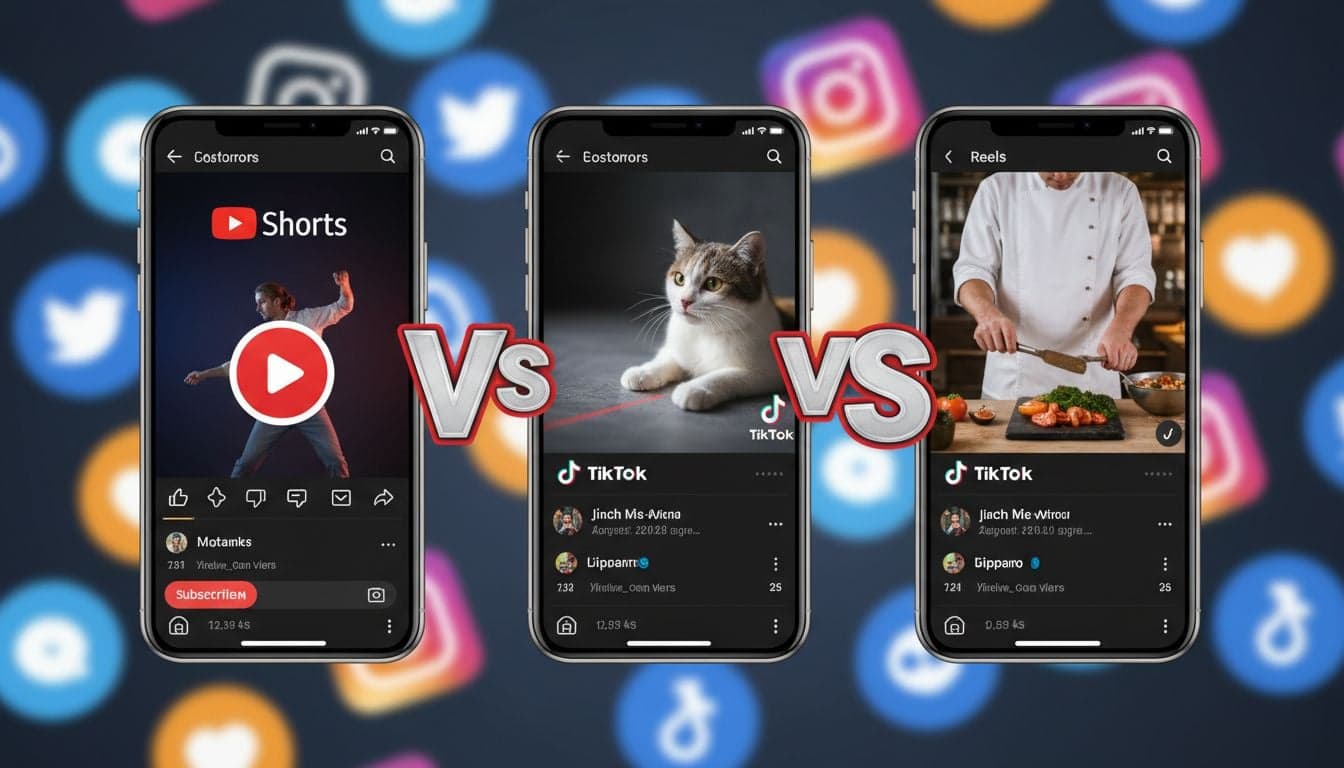
The short-form video market has three dominant players: YouTube Shorts, TikTok, and Instagram Reels. Each platform commands billions of monthly users, yet they serve fundamentally different creator needs and audience behaviors.
Choosing the wrong platform wastes your creative energy. Post gaming content on Instagram Reels and you'll struggle for views. Launch educational content on TikTok without understanding its discovery mechanism and your videos vanish into the void. The platform matters as much as your content quality.
This comparison breaks down the critical differences between YouTube Shorts, TikTok, and Reels across seven dimensions that directly impact your growth and revenue potential.
Audience Demographics and Behavior
Each platform attracts distinct user groups with different content consumption patterns.
YouTube Shorts
YouTube Shorts users trend older, with 46% of the audience aged 25-44. They arrive with intent—often searching for specific topics before discovering Shorts. The platform sees peak engagement during evening hours (7-10 PM) when users transition from traditional YouTube videos to Shorts.
Primary age range: 25-44 years old
Session duration: 12-18 minutes average
Discovery method: Search-driven and recommendation mix
Top categories: Education, tech reviews, how-tos, finance
TikTok
TikTok dominates the 18-24 demographic, representing 42% of its user base. Users open the app with no specific intent—they scroll to be entertained. Average session length exceeds 90 minutes daily, the highest of any social platform.
Primary age range: 18-24 years old
Session duration: 90+ minutes daily
Discovery method: Pure algorithmic feed
Top categories: Entertainment, comedy, dance, lifestyle, trending sounds
Instagram Reels
Reels users skew toward 25-34 year olds who already engage with Instagram's ecosystem. They switch between Stories, posts, and Reels within the same session. Discovery happens primarily through the Explore page and hashtag searches.
Primary age range: 25-34 years old
Session duration: 8-12 minutes for Reels specifically
Discovery method: Explore page, hashtags, following feed
Top categories: Fashion, beauty, food, travel, fitness
Monetization Opportunities
Revenue potential varies dramatically across platforms, with different thresholds and payment structures.
YouTube Shorts Monetization
YouTube introduced the Shorts Fund in 2021, paying creators $100-$10,000 monthly based on performance. The platform now integrates Shorts into the YouTube Partner Program, requiring 1,000 subscribers and 10 million Shorts views in 90 days. Revenue comes from ad revenue pools, with creators earning $0.05-$0.07 per 1,000 views on average.
The real power lies in Shorts driving subscribers to long-form content. Creators report 30-40% of new subscribers discover channels through Shorts, then consume monetized long-form videos.
TikTok Monetization
TikTok's Creator Fund pays $0.02-$0.04 per 1,000 views—the lowest rate among major platforms. You need 10,000 followers and 100,000 video views in 30 days to qualify. Most creators earn $200-$400 monthly from the Creator Fund alone at 1 million monthly views.
Brand partnerships and TikTok Shop drive real revenue. Creators with 100,000 followers command $500-$2,000 per sponsored post. TikTok Shop allows product promotion with commission rates from 5-20%, generating $3,000-$15,000 monthly for successful creators.
Instagram Reels Monetization
Instagram's Reels Play bonus program ended in 2024, replaced by creator marketplace partnerships. The platform focuses on connecting brands with creators rather than direct ad revenue sharing.
Creators monetize through sponsored content ($300-$5,000 per post depending on followers), affiliate marketing, and driving traffic to external products or services. Instagram's shopping features integrate seamlessly with Reels, supporting product tags and links.
Create videos like this with AI
Script, voiceover, images and subtitles — automated in minutes.
Algorithm and Discovery Mechanisms
Understanding how each algorithm surfaces content determines your posting strategy.
YouTube Shorts Algorithm
YouTube Shorts uses a hybrid recommendation system combining viewer history, search intent, and engagement metrics. The algorithm evaluates click-through rate on thumbnails, average view duration (crucial—aim for 50%+ retention), and post-view engagement (subscribes, channel visits).
Unlike TikTok, YouTube weights your existing subscriber base. Videos automatically show to 10-20% of subscribers first. Strong performance with subscribers signals quality to the algorithm, expanding reach to non-subscribers. Learn more in our YouTube Shorts algorithm guide.
Initial push: Shown to subscribers and similar-interest viewers
Performance evaluation: First 24-48 hours determine reach
Extended reach: High retention triggers broader distribution
Search integration: Shorts appear in YouTube search results
TikTok Algorithm
TikTok employs the most aggressive content distribution system. Every video receives an initial test with 200-500 viewers regardless of follower count. The algorithm measures completion rate (watch entire video), replays, shares, and time spent on video screen.
Videos exceeding performance benchmarks enter successive waves, reaching 1,000-5,000 viewers, then 10,000-50,000, potentially millions. The system favors content that keeps users scrolling—controversial, emotionally triggering, or highly entertaining videos outperform educational content.
Initial batch: 200-500 random users
First evaluation: Within 1 hour of posting
Viral potential: Videos can explode days or weeks after posting
Sound integration: Using trending sounds increases initial reach
Instagram Reels Algorithm
Instagram prioritizes content from accounts users already interact with, making it harder to reach new audiences compared to TikTok. The algorithm evaluates saves (strongest signal), shares, comments, and completion rate.
Hashtags still matter on Instagram—use 3-5 relevant tags. Videos using original audio receive less algorithmic push than those using popular Reels sounds. The Explore page serves as the primary discovery mechanism for new audiences.
Connection priority: Shows to existing followers first
Explore placement: High engagement triggers Explore distribution
Hashtag discovery: Users actively search hashtags for content
Cross-posting penalty: TikTok watermarks reduce reach by 40-60%
Content Format Requirements
Technical specifications impact how you produce and optimize videos for each platform.
YouTube Shorts Specs
Maximum length: 60 seconds
Aspect ratio: 9:16 vertical (1080x1920 pixels)
File size: No official limit, recommended under 2GB
Required elements: Must include #Shorts in title or description
Thumbnail: Auto-generated from video frame, not customizable
TikTok Specs
Maximum length: 10 minutes (3-60 seconds optimal for algorithm)
Aspect ratio: 9:16 vertical (1080x1920 pixels preferred)
File size: 287.6 MB on iOS, 72 MB on Android
Required elements: Captions strongly recommended (80% watch without sound)
Text overlay: Limited to 2,200 characters across all text elements
Instagram Reels Specs
Maximum length: 90 seconds (15-30 seconds performs best)
Aspect ratio: 9:16 vertical (1080x1920 pixels)
File size: 4GB maximum
Required elements: Cover image (customizable unlike Shorts)
Music integration: Access to Instagram's licensed music library
Cross-Posting Strategy Considerations
Many creators post the same content across all three platforms. This works for some niches but limits platform-specific growth potential.
The multi-platform approach that works: Create one core video, then adapt for each platform's algorithm preferences. Change hooks, adjust length, modify captions, and upload natively. This requires 30-40% more production time but delivers 200-300% better reach.
When to Focus on One Platform
Concentrate on a single platform if you have limited time or are building initial momentum. You'll master that platform's algorithm nuances, develop a consistent posting rhythm, and build a loyal audience faster.
Choose YouTube Shorts if you plan to monetize through long-form content eventually. Pick TikTok for pure viral potential and rapid audience growth. Select Reels if you already have an Instagram presence or target the 25-34 lifestyle demographic.
Content Type Performance by Platform
Certain content categories dominate each platform based on user expectations and algorithm preferences.
YouTube Shorts Winners
Educational content with clear value propositions
Product reviews and unboxing videos
Quick tutorials and life hacks
Tech tips and software demonstrations
Finance and investment education
Clips from longer YouTube videos (teasers)
TikTok Winners
Entertainment and comedy sketches
Trending dance and lip-sync content
POV (point of view) scenarios
Controversial takes and hot opinions
Behind-the-scenes and day-in-the-life content
Transformation and before/after videos
Instagram Reels Winners
Fashion lookbooks and outfit transitions
Recipe videos and food preparation
Travel destinations and location showcases
Fitness routines and workout tutorials
Beauty tutorials and makeup transformations
Aesthetic lifestyle content
Making Your Platform Decision
Your platform choice depends on three primary factors: content type, monetization timeline, and time investment capacity.
Choose YouTube Shorts if: You create educational, informational, or tutorial content. You want to build a sustainable long-form YouTube channel. You can invest 3-6 months before expecting significant revenue. Your target audience is 25+ and actively searches for solutions.
Choose TikTok if: You create entertainment-focused content. You need rapid audience growth (0 to 10,000 followers in 30-60 days is achievable). You're comfortable with brand deals and product promotion as primary revenue. You target audiences under 30 who scroll for discovery rather than search.
Choose Instagram Reels if: You have an existing Instagram following or business. You create lifestyle, fashion, food, or visually-driven content. You already sell products or services that benefit from Instagram's shopping features. You target the 25-34 demographic with higher purchasing power.
The platforms will continue evolving their features and algorithms. YouTube recently increased Shorts length to 3 minutes. TikTok expanded to 10-minute videos. Instagram keeps iterating on Reels monetization. Your platform choice isn't permanent—successful creators often start on one platform, establish authority, then expand to others.
Focus beats fragmentation. Master one platform's algorithm and content style before spreading your attention across all three. The creators earning $5,000-$50,000 monthly typically dominate one platform first, then strategically expand using their established content systems and audience understanding.