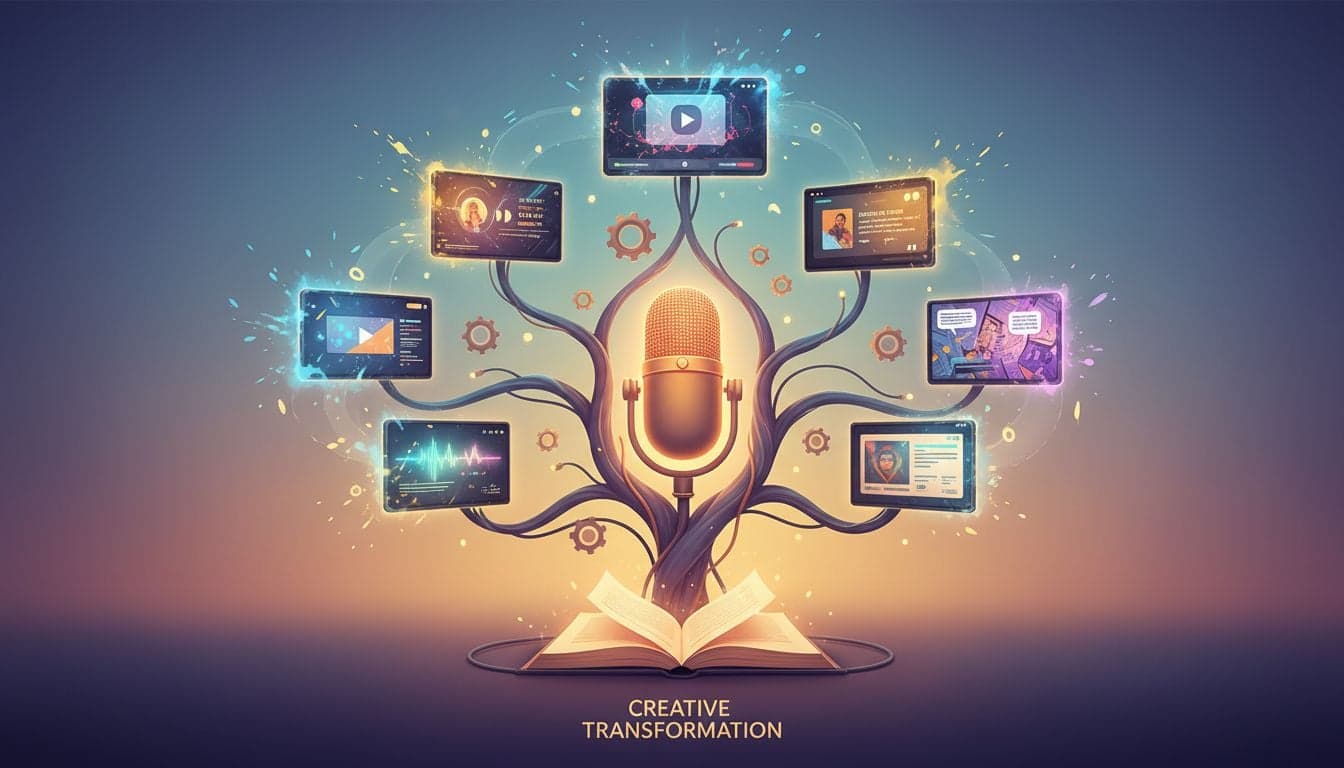
Your podcast episodes contain hours of valuable content that most creators use exactly once. Meanwhile, video content generates 1200% more shares than text and images combined, and platforms prioritize video in their algorithms. The gap between these two facts represents your biggest untapped growth opportunity.
Converting podcast episodes into strategic video content isn't about simply adding a static waveform to your audio file. It's about creating a systematic approach that transforms one 45-minute podcast episode into 15+ pieces of platform-optimized video content that continues working for months after publication.
This strategy has helped podcasters grow their YouTube channels from zero to 50,000 subscribers in six months, triple their podcast downloads through social discovery, and build engaged communities across platforms they previously ignored. Here's the complete framework.
The Three-Tier Podcast Video Strategy
Effective podcast repurposing operates on three distinct levels, each serving different audience behaviors and platform requirements. Most creators focus exclusively on tier one and miss 80% of potential reach.
Tier 1: Full Episode Video Podcasts
Your complete podcast episode becomes a YouTube video with visual elements that maintain viewer attention throughout the full runtime. This tier serves your most engaged audience and establishes your presence in YouTube's podcast ecosystem.
Visual format: Speaker on camera, guest interviews, or AI-generated visuals synchronized to topics discussed.
Target length: Full episode (30-90 minutes) published weekly.
Platform priority: YouTube main channel, Spotify video podcasts.
SEO value: Highest long-tail keyword opportunities, establishes topical authority.
Tier 2: Segment-Based Videos
Extract 5-8 minute segments covering specific topics or questions from your full episode. Each segment becomes a standalone video optimized for discovery and shares.
Visual format: Topic-focused graphics, AI-generated visuals matching segment themes, dynamic captions.
Target length: 4-8 minutes per segment, publish 2-3 per week.
Platform priority: YouTube Shorts, LinkedIn, Facebook.
SEO value: Targets specific search queries, builds content depth around topics.
Tier 3: Micro-Content Clips
60-90 second clips highlighting compelling quotes, actionable tips, or controversial takes. These clips drive discovery and funnel viewers to longer content.
Visual format: High-contrast text overlays, attention-grabbing first frame, optimized captions.
Target length: 45-90 seconds, publish daily.
Platform priority: TikTok, Instagram Reels, YouTube Shorts, X.
SEO value: Minimal direct SEO, maximum social algorithm performance.
Production Workflow for Maximum Efficiency
The difference between overwhelmed creators abandoning this strategy after two weeks and those systematically scaling it comes down to workflow design. This process takes 3-4 hours per podcast episode once established.
Record with repurposing in mind: During podcast recording, verbally mark great moments with phrases like 'that's a clip' or 'mark that timestamp.' This creates natural editing points and reduces review time by 60%.
Generate full transcript immediately: Use the Vexub MP3 to video tutorial workflow to convert your audio file and generate timestamped transcripts. This becomes your content mining document.
Identify tier 2 segments: Review transcript and mark 5-8 segments that answer specific questions or cover distinct topics. Each segment should have a clear hook and resolution.
Extract tier 3 clips: Within each segment, identify 1-2 quotable moments under 90 seconds. Look for controversial opinions, surprising statistics, or actionable advice.
Batch create videos: Use Vexub to generate all tier 2 and tier 3 videos in one session. Apply consistent visual templates per tier for brand recognition.
Optimize for each platform: Adjust aspect ratios, caption styles, and opening hooks based on platform requirements. What works on LinkedIn differs from TikTok.
Create videos like this with AI
Script, voiceover, images and subtitles — automated in minutes.
Platform-Specific Distribution Tactics
Each platform has distinct audience expectations and algorithm preferences. Your tier 1 content rarely succeeds across all platforms without modification, but tiers 2 and 3 can dominate when properly adapted.
YouTube Strategy
Publish tier 1 full episodes on your main channel weekly. Create a second 'Clips' channel for tier 2 segments or organize them in playlists on your main channel. Use YouTube Shorts for tier 3 content, but prioritize strong thumbnails and titles over algorithm gaming.
Timing: Full episodes Thursday-Friday, segments Monday-Wednesday, Shorts daily.
Optimization: Timestamp chapters in full episodes, extract those chapters as segment videos, link between related content in descriptions.
SEO focus: Target question-based keywords in titles and descriptions for segments.
TikTok and Instagram Reels
These platforms reward tier 3 content exclusively. Your 60-second clips with strong hooks, optimized captions, and native vertical formatting perform best. Avoid linking out in captions; use profile links and comments.
Timing: Post 1-3 clips daily, test different posting times across two weeks.
Optimization: First 3 seconds determine success. Start with the payoff, not the setup.
Hashtag strategy: Mix 3-5 niche-specific tags with 1-2 broader discovery tags.
LinkedIn Approach
Tier 2 segments (4-8 minutes) perform exceptionally on LinkedIn when positioned as professional insights. Add context in your post copy explaining why this matters to your professional audience. LinkedIn's algorithm favors native video uploads over links.
Timing: Tuesday-Thursday mornings (8-10 AM in your audience's timezone).
Optimization: Start posts with a question or bold statement, embed the video, end with discussion prompt.
Engagement focus: Respond to every comment within the first 2 hours to boost algorithmic distribution.
Content Selection Framework
Not every podcast moment deserves video treatment. Strategic selection multiplies your effort's impact. Apply this filtering system to identify high-potential content.
The VASE Framework
Value: Does this segment solve a specific problem or answer a common question? Tier 2 content must deliver standalone value.
Attention: Does the opening 5 seconds hook viewers with conflict, curiosity, or surprise? Essential for tier 3 clips.
Shareability: Would viewers send this to a colleague or friend? Controversial opinions and counterintuitive insights score highest.
Evergreen potential: Will this remain relevant in 6-12 months? Prioritize timeless content over news commentary for long-term SEO value.
Visual Enhancement Strategies
Audio-only content loses 70% of viewers within 30 seconds on video platforms. Strategic visual elements maintain attention and increase watch time, directly impacting algorithmic performance.
For Full Episodes (Tier 1)
On-camera presence: Speaker visibility increases watch time by 45% compared to static images. Face reactions matter more than production quality.
Guest splits: Show both speakers in split-screen during interviews. Single-speaker shots reduce engagement.
B-roll integration: When discussing specific topics, overlay relevant visuals for 3-5 second segments. Maintains visual variety without distraction.
AI-generated visuals: For faceless content, use Vexub's AI image generation to create topic-relevant scenes that change every 8-12 seconds.
For Segments (Tier 2)
Dynamic text overlays: Highlight key phrases and statistics as on-screen text. Viewers retain 80% more information when audio and visual text align.
Progress indicators: Show viewers how far through the segment they are. Reduces early drop-off by 30%.
Chapter markers: For longer segments, add visual chapter breaks every 90-120 seconds with topic labels.
For Clips (Tier 3)
Captions always: 85% of social video plays with sound off initially. Captions aren't optional—they're essential for stopping the scroll.
Brand consistency: Use identical caption styles, fonts, and color schemes across all clips. Recognition builds faster than variety.
Strategic framing: Place speaker in lower third of vertical videos, leaving upper two-thirds for text overlays and visual elements.
Monetization Multiplication
Video repurposing doesn't just expand reach—it creates multiple revenue streams from single content pieces. Podcasters implementing this strategy report 3-4x revenue increases within six months.
Direct Platform Revenue
YouTube Partner Program monetizes tier 1 full episodes through ads. YouTube Shorts monetization rewards tier 3 clip performance. Spotify video podcasts increase listener session length, improving recommendation algorithm performance and sponsor appeal.
Sponsor Package Enhancement
Offer sponsors multi-platform exposure: mentions in the podcast, visual integration in full episode videos, dedicated tier 2 segments, and tier 3 clips. This integrated approach commands 2-3x higher rates than audio-only sponsorships.
Affiliate Marketing Amplification
Video allows product demonstrations and visual comparisons impossible in audio. Create tier 2 segments around product reviews or tutorials, using Vexub to add product imagery and feature callouts. Conversion rates increase 5-8x compared to audio mentions alone.
Course and Product Promotion
Use tier 2 segments as lead magnets for email lists. Create segment playlists that serve as free mini-courses, ending with calls-to-action for paid offerings. This content repurposing approach builds automated sales funnels.
Measurement and Optimization
Track these metrics weekly to identify what's working and double down on winning patterns. Most creators measure vanity metrics while ignoring signals that actually predict growth.
Primary Metrics
Cross-platform podcast growth: Are video clips driving new podcast subscribers? Track referral sources in podcast analytics.
Watch time per tier: Compare average watch percentage across tiers. If tier 2 segments underperform, shorten them or improve hooks.
Clip-to-full conversion: What percentage of clip viewers watch full episodes? This reveals content-market fit.
Production time per tier: Are you getting faster? If workflow time increases, identify bottlenecks and eliminate them.
Secondary Signals
Comment sentiment: Are viewers asking questions or demanding more? Engagement quality matters more than quantity.
Shares and saves: High save rates on Instagram and TikTok signal evergreen content worth repurposing again.
Traffic source variety: Is content discovered through search, suggestions, or shares? Diversified discovery reduces platform risk.
Common Mistakes That Kill Results
These errors prevent 90% of podcasters from sustaining their video repurposing strategy beyond the first month. Avoid them to maintain momentum.
Perfectionism Over Consistency
Waiting for professional equipment, perfect lighting, or flawless editing prevents publishing. Consistent content with decent production beats sporadic content with perfect production every time. The algorithm rewards frequency and reliability.
Platform Ignorance
Posting identical content across all platforms wastes 70% of your effort. Each platform has distinct optimal formats, lengths, and audience expectations. Adapt or underperform.
No Clear Call-to-Action
Every video should tell viewers what to do next. Without explicit CTAs, you entertain but don't convert. Direct traffic intentionally: to full episodes, email lists, or community spaces.
Ignoring Analytics
Publishing without reviewing performance data means repeating failures and missing successes. Dedicate 30 minutes weekly to analytics review. Let data guide content decisions.
Underestimating SEO
Video titles, descriptions, and tags determine discoverability. Generic titles like 'Episode 47' waste search potential. Use specific, benefit-focused titles that answer questions viewers are actively searching.
Scaling Beyond Manual Creation
Once you've proven the strategy works, automation and delegation unlock exponential growth without proportional time investment. This transforms podcast repurposing from side project to revenue engine.
Batch Recording
Record 4-6 podcast episodes in one day, then repurpose them over the following month. This reduces context switching and allows focused creation blocks for both recording and video production.
Template Systems
Create saved video templates for each content tier in Vexub. Pre-set visual styles, caption formats, music choices, and export settings. New videos require only audio and text inputs, reducing production time by 60%.
Team Delegation
As revenue grows, delegate specific tasks: transcript review to a VA, clip selection to an editor familiar with your content, social posting to a community manager. Retain creative control over segment selection and final approval.
AI-Assisted Workflows
Use AI tools to accelerate every step: automatic transcript generation, AI-suggested clip timestamps, automated caption creation, and AI-generated visual assets. Vexub handles most of these workflows natively, eliminating tool-switching overhead.
Your 30-Day Implementation Plan
Start small and prove the concept before committing to full-scale implementation. This 30-day plan builds skills progressively while generating results that justify continued investment.
Week 1: Foundation
Select your three best-performing podcast episodes from the past 90 days.
Generate transcripts and identify 5 tier 2 segments per episode.
Create one tier 2 video using Vexub and publish on YouTube.
Extract 3 tier 3 clips from that segment and post across TikTok, Instagram, LinkedIn.
Week 2: Process Refinement
Analyze week 1 performance: which platforms and formats drove the most engagement?
Create visual templates in Vexub for your best-performing format.
Produce tier 2 segments from your second selected episode.
Post tier 3 clips daily across your top 2 performing platforms.
Week 3: Volume Increase
Repurpose your third selected episode into full tier 1, tier 2, and tier 3 content.
Establish a posting schedule: which content types go live on which days.
Begin tracking metrics in a simple spreadsheet: views, watch time, podcast referrals.
Test different posting times to identify optimal windows per platform.
Week 4: Optimization and Planning
Review 30 days of performance data. Which segments drove the most podcast growth?
Identify patterns in high-performing content: topics, formats, lengths.
Plan next month's content calendar based on successful patterns.
Document your workflow and time per task to identify optimization opportunities.
By day 30, you'll have published 15-20 videos across multiple platforms, gathered actionable performance data, and established a repeatable workflow. Results at this stage justify scaling effort.
Beyond Repurposing: Compound Growth Effects
Strategic podcast video repurposing creates compound benefits that extend far beyond simple view counts. These secondary effects often deliver more value than direct metrics.
Authority Building: Consistent video presence across platforms establishes you as a credible voice in your niche. Speaking on camera builds trust faster than audio alone, increasing conversion rates on all offers.
Network Effects: Video clips facilitate collaborations and guest appearances. Other creators discover your content through social platforms, leading to partnership opportunities unavailable through audio-only podcasting.
Content Longevity: Video content continues generating views and podcast referrals months or years after publication. Strong SEO optimization creates evergreen traffic sources that compound over time.
Audience Insights: Video engagement patterns reveal which topics resonate most strongly. Use this feedback to guide future podcast episode topics, creating a virtuous cycle of increasingly relevant content.
The podcasters who implement this strategy consistently report the same revelation: their podcast becomes the content engine fueling growth across every platform, rather than an isolated audio product competing for limited podcast listener attention. Video distribution transforms podcast ROI from linear to exponential.
Start with your next episode. Apply the VASE framework to identify three segments worth repurposing. Create those videos. Publish strategically. Measure results. Refine your approach. The compound effects begin immediately, but the true transformation becomes undeniable within 90 days of consistent execution.